
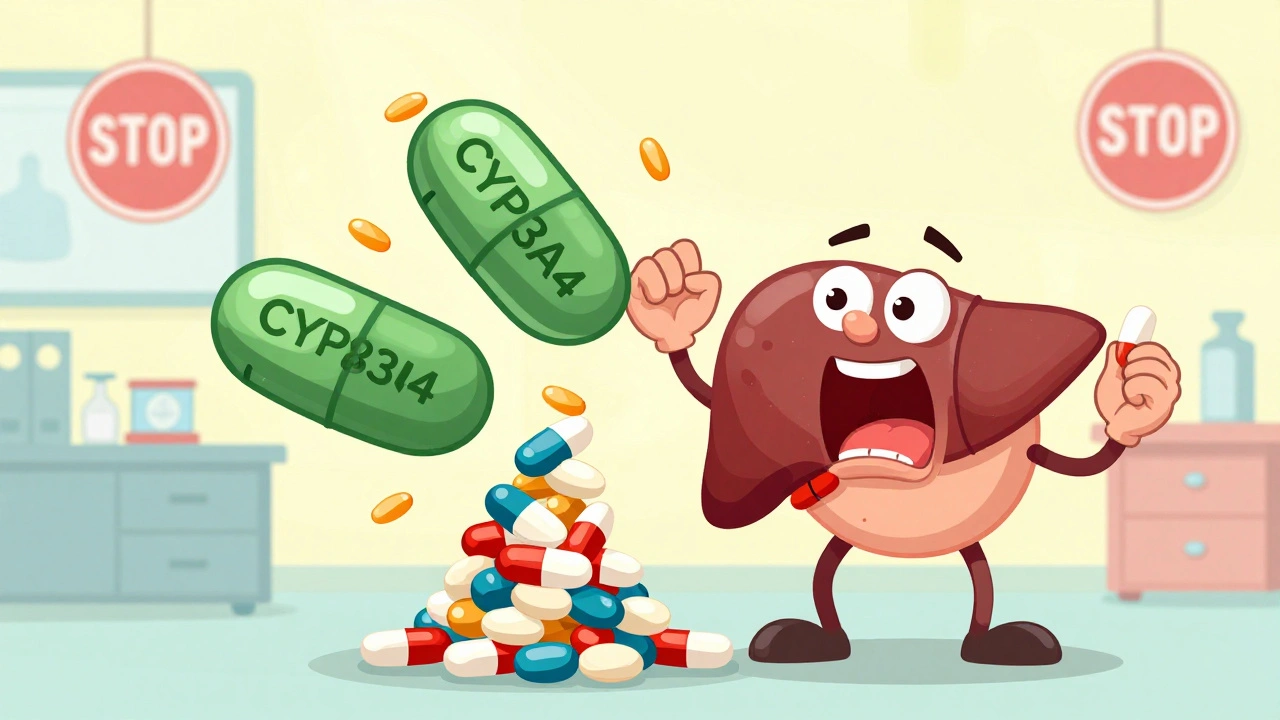
Imagine you’re taking a statin to keep your cholesterol in check, and then you get a stubborn fungal infection-maybe athlete’s foot, a yeast infection, or a bad toenail. Your doctor prescribes an antifungal like fluconazole or itraconazole. Everything seems fine… until your muscles start aching badly, turning into a deep, unrelenting pain that makes walking hard. You end up in the ER with muscle damage so severe your blood test shows creatine kinase levels over 15,000 U/L. That’s not a coincidence. It’s a known, preventable drug interaction between statins and certain antifungals.
Why This Interaction Happens
Statins and azole antifungals work in very different ways, but they meet in a dangerous spot inside your liver: the CYP3A4 enzyme. This enzyme is like a factory worker that breaks down certain drugs so your body can get rid of them. Statins like simvastatin, lovastatin, and atorvastatin rely on CYP3A4 to be processed. But azole antifungals-especially itraconazole, ketoconazole, and voriconazole-shut down this enzyme like flipping a switch. When that happens, your statin doesn’t get broken down. It builds up in your blood, sometimes to dangerous levels.One study showed that taking itraconazole with simvastatin can spike simvastatin levels by up to 10 times. That’s not a small bump-it’s a red alert. The result? A rare but life-threatening condition called rhabdomyolysis. This is when muscle tissue breaks down and spills into your bloodstream, potentially causing kidney failure. Cases like this aren’t just theoretical. Pharmacists in the U.S. report catching at least a dozen dangerous combinations each quarter, mostly involving simvastatin and itraconazole for toenail fungus.
Not All Statins Are Created Equal
The risk isn’t the same for every statin. Some are much safer to use with antifungals because they don’t depend on CYP3A4 at all.- High-risk statins: Simvastatin, lovastatin, atorvastatin (metabolized by CYP3A4)
- Moderate-risk statin: Fluvastatin (metabolized by CYP2C9-can still interact with fluconazole)
- Low-risk statins: Pravastatin, rosuvastatin (mostly cleared by the kidneys, not the liver)
If you’re on simvastatin and need an antifungal, your doctor should switch you to pravastatin or rosuvastatin. These two don’t cause the same dangerous buildup. In fact, a 2022 survey found that 87% of patients who made this switch had no issues with their cholesterol control.
What Antifungals Are Safe?
Not all antifungals are risky. Some don’t touch CYP3A4 at all. That’s good news if you need treatment.- Avoid: Itraconazole, ketoconazole, voriconazole, posaconazole (strong CYP3A4 inhibitors)
- Use with caution: Fluconazole (moderate CYP2C9 inhibitor-can affect fluvastatin)
- Safer options: Terbinafine, nystatin, clotrimazole (topical), ciclopirox
For something like athlete’s foot or a mild yeast infection, a topical cream or spray often works just as well as a pill-and it doesn’t enter your bloodstream enough to cause interactions. The Infectious Diseases Society of America says topical treatments are 70% effective for superficial fungal infections. Start there before reaching for a pill.

What If You Can’t Avoid the Combination?
Sometimes, you need the strong antifungal. Maybe you have a resistant fungal infection, like Candida auris, which is rising fast in hospitals. In those cases, you might not have a choice.If you must take a high-risk antifungal like itraconazole with a CYP3A4-metabolized statin, follow these steps:
- Confirm the infection with a lab test-don’t guess.
- Ask your doctor if a topical treatment is possible.
- If you need an oral antifungal, switch to pravastatin or rosuvastatin.
- If switching isn’t possible, temporarily stop the statin for at least 2 days before starting the antifungal, and wait 2 days after finishing it before restarting the statin.
This approach, backed by a 2016 case report, has helped many patients avoid muscle damage while still treating their infection.
There’s a Silver Lining
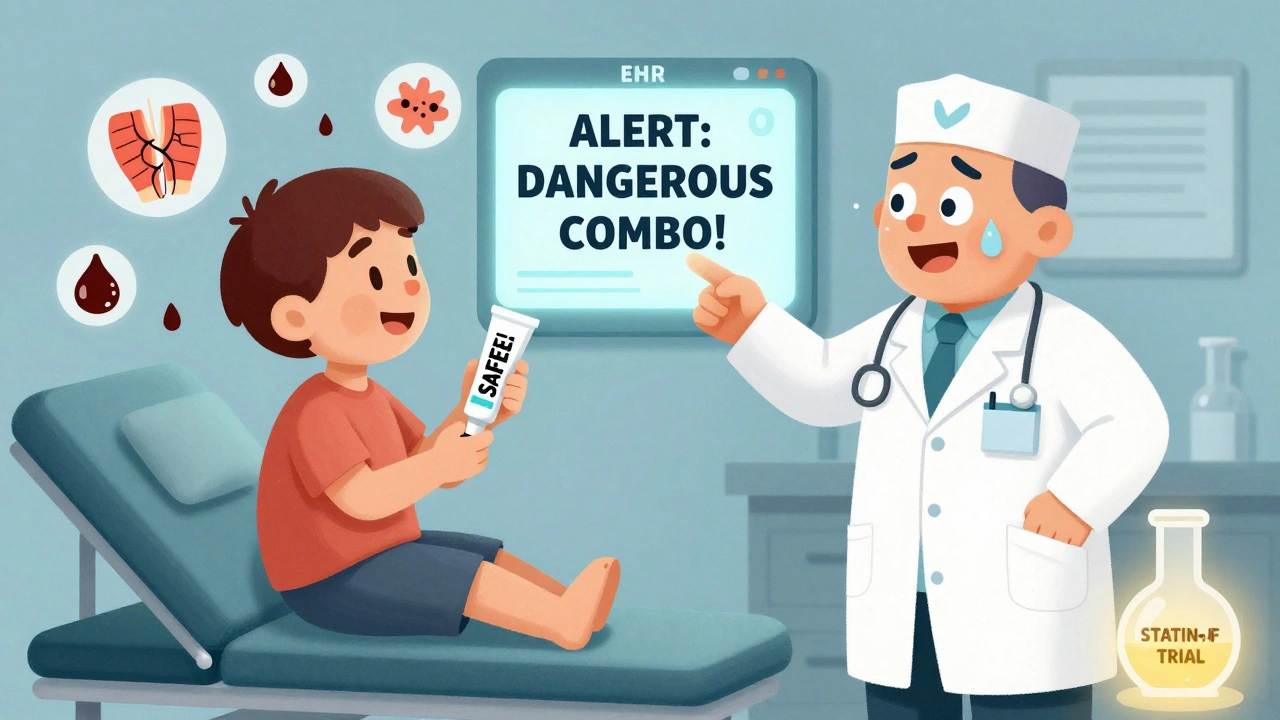
Here’s something surprising: research shows that statins might actually help fight fungi. Studies from 2012 and 2020 found that statins like fluvastatin and atorvastatin can weaken Candida species by disrupting their cell membranes-similar to how antifungals work. In lab tests, combining low doses of statins with azoles made the antifungals work better, even against drug-resistant strains like Candida auris.The NIH is now running a trial called STATIN-AF (NCT05678912) to see if giving statins alongside antifungals could improve outcomes for patients with serious fungal infections. Early data suggests statin users have a 32% lower risk of complications from candidemia. This doesn’t mean you should take statins to treat fungus-it’s still being studied-but it shows this interaction isn’t all bad. It’s complex.
What Patients Are Saying
On patient forums, stories are mixed. One person on the American Heart Association’s support network shared how they ended up in the ER after starting fluconazole for a yeast infection while on simvastatin. Their muscle pain was so bad they couldn’t stand. Another user on Reddit, a pharmacist, said they’ve flagged over a dozen dangerous prescriptions this year alone.But there are success stories too. Many patients who switched to pravastatin or rosuvastatin during antifungal treatment reported no change in their cholesterol levels or side effects. The key? Communication. Too many patients don’t tell their doctor about every medication they’re taking. And too many doctors don’t ask.
What You Should Do Right Now
If you’re on a statin and think you might need an antifungal:- Check your statin name. Is it simvastatin, lovastatin, or atorvastatin? If yes, you’re at higher risk.
- Don’t start any antifungal pill without talking to your doctor or pharmacist.
- Ask: “Is there a topical option?” or “Can I switch to pravastatin or rosuvastatin while I’m on this?”
- Know the signs of muscle damage: unexplained muscle pain, weakness, or dark urine. Call your doctor immediately if you notice these.
The FDA and European Medicines Agency have both updated labels to warn against combining simvastatin with itraconazole. But warnings don’t stop mistakes. Only you and your healthcare team can make sure you’re safe.
What’s Changing in 2025
Electronic health record systems like Epic are rolling out new alerts in late 2024 that will flag dangerous statin-azole combinations before the prescription is even filled. That’s a big step forward. But until those systems are fully in place, the responsibility still falls on you to ask the right questions.With fungal infections on the rise-Candida auris cases in the U.S. jumped 200% in 2023-and over 99 million American adults on statins, this interaction is becoming more common, not less. The good news? It’s preventable. You don’t need to choose between your heart health and your fungal infection. You just need to speak up, ask for alternatives, and make sure your care team knows every medication you’re taking.
Can I take fluconazole with my statin?
It depends on your statin. Fluconazole mainly affects CYP2C9, so it’s risky with fluvastatin but less so with others. If you’re on simvastatin, lovastatin, or atorvastatin, fluconazole is usually okay in low doses, but your doctor should still monitor you. For safety, switching to pravastatin or rosuvastatin is the best move.
What are the signs of statin-induced rhabdomyolysis?
Severe muscle pain, especially in the shoulders, thighs, or lower back; unexplained weakness; dark, tea-colored urine; and fatigue. If you feel this way while on both a statin and an antifungal, seek medical help immediately. A simple blood test can check your creatine kinase levels.
Is it safe to take terbinafine with statins?
Yes. Terbinafine doesn’t inhibit CYP3A4 or CYP2C9, so it has no known significant interaction with any statin. It’s often the preferred oral antifungal for toenail fungus in patients on statins because it’s effective and safe.
Can I restart my statin after finishing an antifungal?
Wait at least 2 days after your last dose of the antifungal before restarting your statin. This gives your liver time to clear the antifungal and restore normal enzyme function. If you’re on a high-risk statin like simvastatin, always check with your doctor before restarting.
Should I stop my statin if I get a fungal infection?
Not always. If you’re on pravastatin or rosuvastatin, you likely don’t need to stop. If you’re on simvastatin, lovastatin, or atorvastatin, and you’re taking a strong antifungal like itraconazole, you should pause your statin during treatment. Always consult your doctor before stopping any medication.


Post A Comment