
Serotonin Syndrome Symptom Checker
Check Your Symptoms
Select symptoms you're experiencing. This tool is based on the Hunter Serotonin Toxicity Criteria used by medical professionals.
Cognitive Symptoms
Neuromuscular Symptoms
Autonomic Symptoms
Results
Emergency Response Required
No symptoms selected
When you start or adjust an SSRI like sertraline, fluoxetine, or escitalopram, you’re told to watch for side effects-nausea, insomnia, maybe a headache. But few people know that within hours, something far more dangerous can happen: serotonin syndrome. It’s not rare. It’s not theoretical. It’s a real, fast-moving medical emergency that kills 2-12% of severe cases if not treated quickly. And it’s often missed.
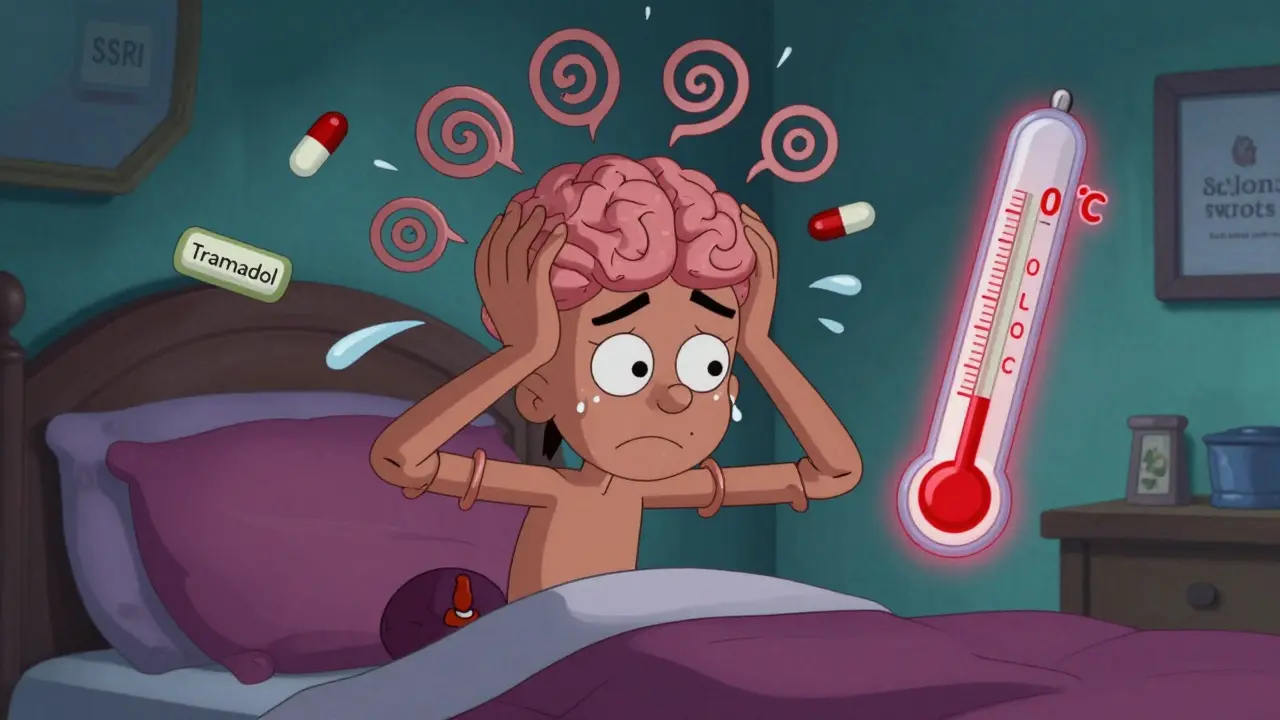
Imagine this: You’ve been on fluoxetine for three months. Your depression is under control. Then your doctor adds tramadol for back pain. Four hours later, you start shaking uncontrollably. Your heart races to 130 beats per minute. You’re drenched in sweat, confused, and can’t stop your muscles from twitching. You call your doctor. They think it’s anxiety. You go to the ER. They give you a sedative. You’re sent home. Two hours later, your temperature hits 40°C. You collapse. This isn’t fiction. It’s a documented case from May 2023 on Reddit’s r/SSRI community. And it happens more often than you think.
What Exactly Is Serotonin Syndrome?
Serotonin syndrome isn’t an allergy. It’s not an overdose in the traditional sense. It’s a chemical storm in your brain. SSRIs work by blocking serotonin reuptake, so more of it stays around to lift your mood. But when you add another drug that also boosts serotonin-like tramadol, MDMA, certain painkillers, or even St. John’s Wort-you overload the system. Too much serotonin floods the 5-HT1A and 5-HT2A receptors. That’s when your body goes into overdrive.
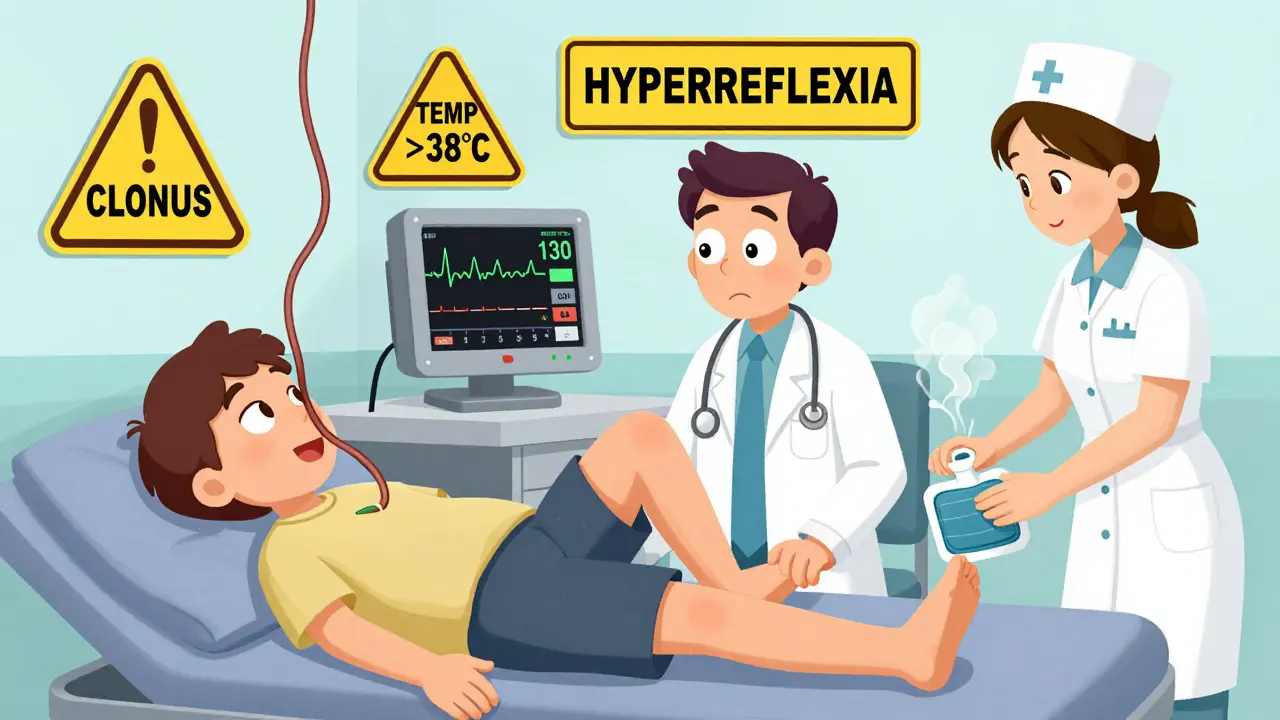
The Hunter Serotonin Toxicity Criteria is the gold standard for diagnosis. It’s not guesswork. It’s based on clinical patterns seen in thousands of cases. To meet the criteria, you need one of these combinations:
- Spontaneous clonus (your leg jerks on its own)
- Inducible clonus + agitation or diaphoresis (sweating)
- Ocular clonus + agitation or diaphoresis
- Tremor + hyperreflexia
- Hypertonia + temperature over 38°C + ocular or inducible clonus
That’s it. No blood test. No scan. Just observation. And if you see clonus-especially in the eyes or legs-you’re looking at serotonin syndrome until proven otherwise.
The Three Warning Signs You Can’t Ignore
Serotonin syndrome shows up in three clear areas: your mind, your muscles, and your body’s internal controls. Missing one means missing the whole picture.
Cognitive symptoms come first. Agitation is the most common-92% of cases. You feel restless, panicked, or confused. You might hear things that aren’t there. Hallucinations happen in over a third of cases. This isn’t psychosis from schizophrenia. This is a drug reaction. People often mistake it for a panic attack or manic episode.
Neuromuscular symptoms are the most telling. Clonus-repetitive muscle contractions-is the #1 red flag. Try this: gently flex someone’s foot. If the foot jerks up and down three or more times, that’s inducible clonus. Ocular clonus? Look at their eyes. If they flicker rapidly side to side without them trying, that’s a classic sign. Tremors, muscle rigidity, and exaggerated reflexes (hyperreflexia) follow. You can’t fake this. It’s not anxiety. It’s a nervous system short-circuit.
Autonomic symptoms are the body’s alarm bells. Sweating? Check. Fast heartbeat? Check. High or low blood pressure? Check. Temperature over 38.5°C? That’s serious. Diarrhea? Yes, it’s part of it. These aren’t side effects. They’re signs your body is burning through energy because your muscles are locked in constant contraction.
Severity Levels: Mild, Moderate, Severe
Not every case is a crisis. But the difference between mild and severe can be measured in hours.
- Mild: Symptoms in one or two categories. Temperature below 38.5°C. You’re anxious, maybe shaky, slightly sweaty. You can still walk. This can be handled at home-if you act fast.
- Moderate: All three categories involved. Temperature between 38.5°C and 41.1°C. You’re confused, rigid, sweating heavily, heart rate over 120. You can’t calm down. You need the ER.
- Severe: Temperature above 41.1°C (106°F), severe muscle rigidity, seizures, or organ failure. This is a death sentence if not treated in under two hours. The body is overheating because muscles are spasming nonstop. No fever medicine will help. You need ICU-level care.
Here’s the scary part: 43% of ER doctors in a 2022 survey didn’t realize severe cases can go from mild to life-threatening in just 4-6 hours. That’s less time than a Netflix episode.
Emergency Response: What Actually Works
Stop the drug. That’s step one. Always. No exceptions. If you suspect serotonin syndrome, stop every SSRI, SNRI, tramadol, triptan, or other serotonergic agent immediately.
Mild cases: IV fluids (1-2 liters of normal saline), benzodiazepines like lorazepam (1-2mg IV) to calm the nervous system, and observation for 12-24 hours. No restraints. Ever. Physical restraints increase muscle activity, which makes the fever worse. That’s not just a bad idea-it’s dangerous.
Moderate cases: Same as above, but add active cooling. Fans, misting with water, cool packs on armpits and groin. Use ondansetron for nausea-no serotonin-blocking antiemetics. Monitor temperature every 15 minutes. You’re watching for progression to severe.
Severe cases: This is a code. Airway first. Intubate. Paralyze with rocuronium to stop muscle spasms. Cool aggressively-ice packs, cooling blankets, even cold IV fluids. Give midazolam IV to control seizures. Benzodiazepines are your best friend here. They reduce agitation, prevent seizures, and lower metabolic demand. Acetaminophen? Ibuprofen? Useless. The fever isn’t from your brain’s thermostat. It’s from muscles burning fuel. Only stopping the spasms will cool you down.
Cyproheptadine? It’s an antihistamine that blocks serotonin receptors. Dose: 12mg orally or via NG tube, then 2mg every 2 hours. Evidence is weak-it’s based on case reports. But if you have it, give it. It might help. The 2024 NEJM study on dantrolene (1mg/kg IV) showed it cut mortality in severe cases from 11.3% to 4.7%. That’s a game-changer. It’s not yet standard everywhere, but it’s coming.
What Doesn’t Work (And Why It’s Dangerous)
Many people think serotonin syndrome is like a fever. They reach for Tylenol. They think rest will fix it. They don’t realize they’re making it worse.
- Acetaminophen or ibuprofen: These target the brain’s temperature control center. Serotonin syndrome isn’t about that. It’s about muscle heat. Giving these gives false reassurance and delays real treatment.
- Physical restraints: They increase muscle tension. More tension = more heat. More heat = more risk of organ failure. That’s why the American College of Medical Toxicology says: never restrain.
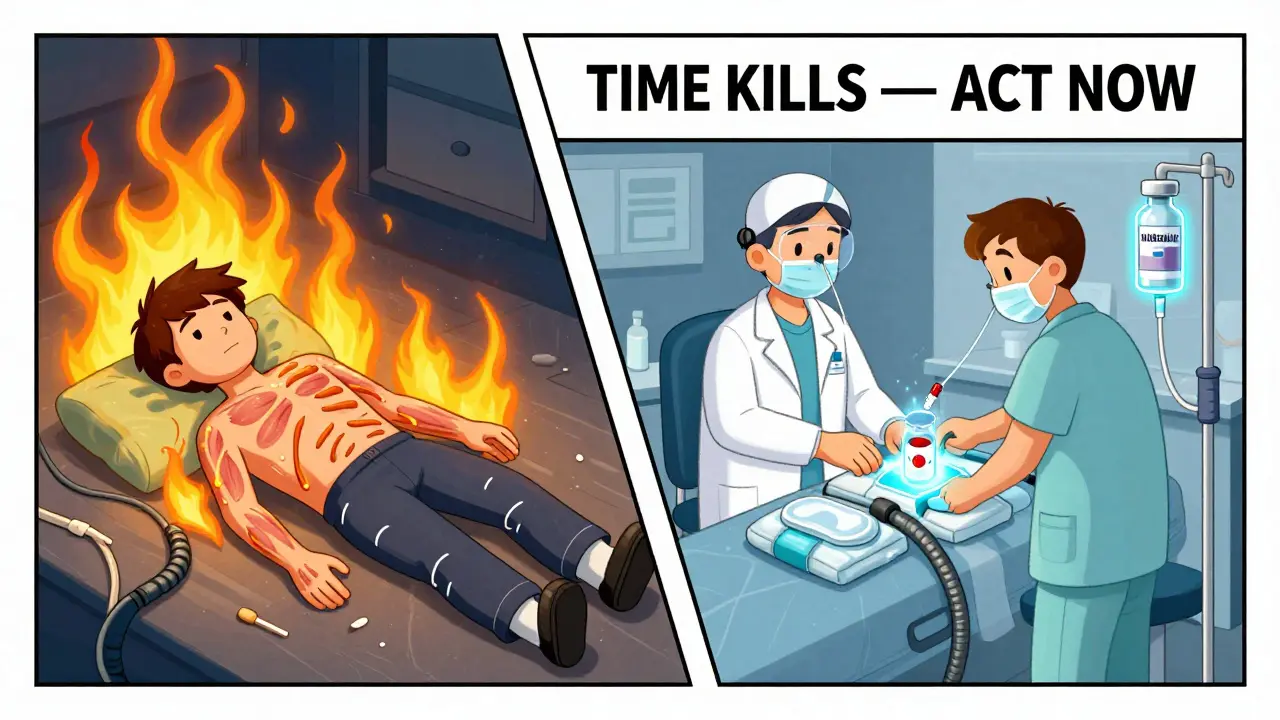
- Waiting to see if it gets better: A 2021 study in Critical Care Medicine found 11.3% of patients died when treatment was delayed over six hours. If treated within two hours, mortality dropped to 2.1%. Time kills.
Who’s at Risk? The High-Risk Combinations
It’s not just SSRIs alone. It’s the mix that kills.
- SSRI + MAOI (like phenelzine): 12.4x higher risk
- SSRI + tramadol: 8.7x higher risk
- SSRI + triptans (for migraines): 3.2x higher risk
- SSRI + dextromethorphan (cough syrup): 5.1x higher risk
- SSRI + St. John’s Wort: 3.8x higher risk
Fluoxetine (Prozac) is especially tricky. Its metabolite, norfluoxetine, sticks around for weeks. So even if you stop it, the risk lingers. Someone on fluoxetine who starts another SSRI? They’re playing Russian roulette.
And here’s the kicker: FDA black box warnings exist. But a 2023 review found only 43% of patient medication guides include them. You’re not being warned. That’s a system failure.
Real Stories, Real Consequences
A 52-year-old woman in Melbourne was on sertraline for anxiety. She took tramadol for a slipped disc. Four hours later, she had ocular clonus and a temperature of 39.4°C. She was misdiagnosed with a panic attack. By the time she got to the ER, she’d been untreated for eight hours. She spent three days in ICU. She recovered-but not everyone does.
Another patient on fluoxetine took a single dose of MDMA at a party. He went into cardiac arrest. He survived. He now carries a medical alert card. He says: "I didn’t know serotonin syndrome could kill me from a pill I took for back pain. I thought it was just for drug addicts."
92% of mild-to-moderate cases resolve in 24-72 hours after stopping the drug. That’s the good news. The bad news? The ones who don’t get treated fast enough? They don’t make it.
What You Should Do Now
If you’re on an SSRI:
- Know the signs: clonus, sweating, fast heartbeat, confusion.
- Never combine SSRIs with tramadol, triptans, or OTC cough meds without checking with a pharmacist.
- Ask your doctor: "Could this new medication interact with my SSRI?" Don’t assume they know.
- Use the Serotonin Alert app. It checks drug interactions with 92% accuracy.
- If you feel sudden shivering, muscle rigidity, or confusion after a new drug-go to the ER. Say: "I think I have serotonin syndrome." Don’t wait.
If you’re a caregiver for someone on SSRIs:
- Keep a list of all medications they take, including supplements.
- Watch for changes in behavior or movement.
- If they suddenly can’t stop shaking or are sweating like they’ve run a marathon-call an ambulance.
Can serotonin syndrome happen from one SSRI alone?
Yes, though it’s less common. It usually happens with a high dose, rapid dose increase, or in people with liver problems that slow drug metabolism. Cases have been documented with fluoxetine doses above 80mg/day or escitalopram above 30mg/day. It’s rare, but possible.
How long does serotonin syndrome last?
Mild cases clear in 24 hours. Moderate cases take 1-3 days. Severe cases can take up to a week. Fluoxetine is the exception-its effects can linger for 3-4 weeks because its metabolite, norfluoxetine, has a half-life of up to 15 days. That’s why stopping fluoxetine doesn’t mean the risk is gone.
Is serotonin syndrome the same as neuroleptic malignant syndrome?
No. NMS comes from antipsychotics, not SSRIs. It develops over days, not hours. NMS causes "lead-pipe" rigidity (constant stiffness), while serotonin syndrome causes clonus and hyperreflexia. NMS has high creatine kinase and low temperature early on. Serotonin syndrome has high temperature and clonus from the start.
Can I use benzodiazepines at home if I think I have serotonin syndrome?
No. Benzodiazepines require medical supervision. Taking them without knowing the cause could mask symptoms or worsen low blood pressure. If you suspect serotonin syndrome, go to the ER. Don’t self-treat.
Are there any long-term effects after surviving serotonin syndrome?
Most people recover fully. But severe cases that involved prolonged hyperthermia or seizures can lead to muscle damage, kidney injury, or neurological deficits. Recovery is possible, but it takes time. Follow-up with a psychiatrist is essential to safely restart antidepressants-usually with a different class like bupropion or mirtazapine.
Serotonin syndrome isn’t a mystery. It’s a predictable, preventable emergency. The tools to recognize it exist. The treatments work-if they’re given fast enough. The problem isn’t science. It’s awareness. If you’re on an SSRI, know the signs. If someone you care about is, learn them too. Because in this case, minutes matter more than medication.


Post A Comment