
Blood Thinner & Antiviral Interaction Checker
This tool helps you check for dangerous interactions between blood thinners and antiviral medications for COVID-19. Always consult with your doctor or pharmacist before making any changes to your medication regimen.
Only required for Dabigatran. Enter your creatinine clearance rate in mL/min.
When COVID-19 Turns Your Blood Thinners Dangerous
If you’re on a blood thinner like rivaroxaban, apixaban, or warfarin, and you catch a bad respiratory infection - especially COVID-19 - your medication can suddenly become unpredictable. It might stop working, or worse, it could turn too strong and start causing internal bleeding. This isn’t theoretical. It’s happening in hospitals and pharmacies right now, and it’s one of the most dangerous, overlooked drug interactions of the last decade.
During the peak of the pandemic, doctors noticed something strange: patients on blood thinners were bleeding for no clear reason, or suddenly developing clots despite being on therapy. The culprit wasn’t the virus alone - it was how the virus’s treatments clashed with anticoagulants. The body’s response to SARS-CoV-2 triggers a hypercoagulable state, meaning your blood thickens abnormally. That’s why many hospitalized patients needed stronger anticoagulation than usual. But then came the antivirals - and everything got messy.
How Paxlovid and Other Antivirals Mess With Your Blood Thinner
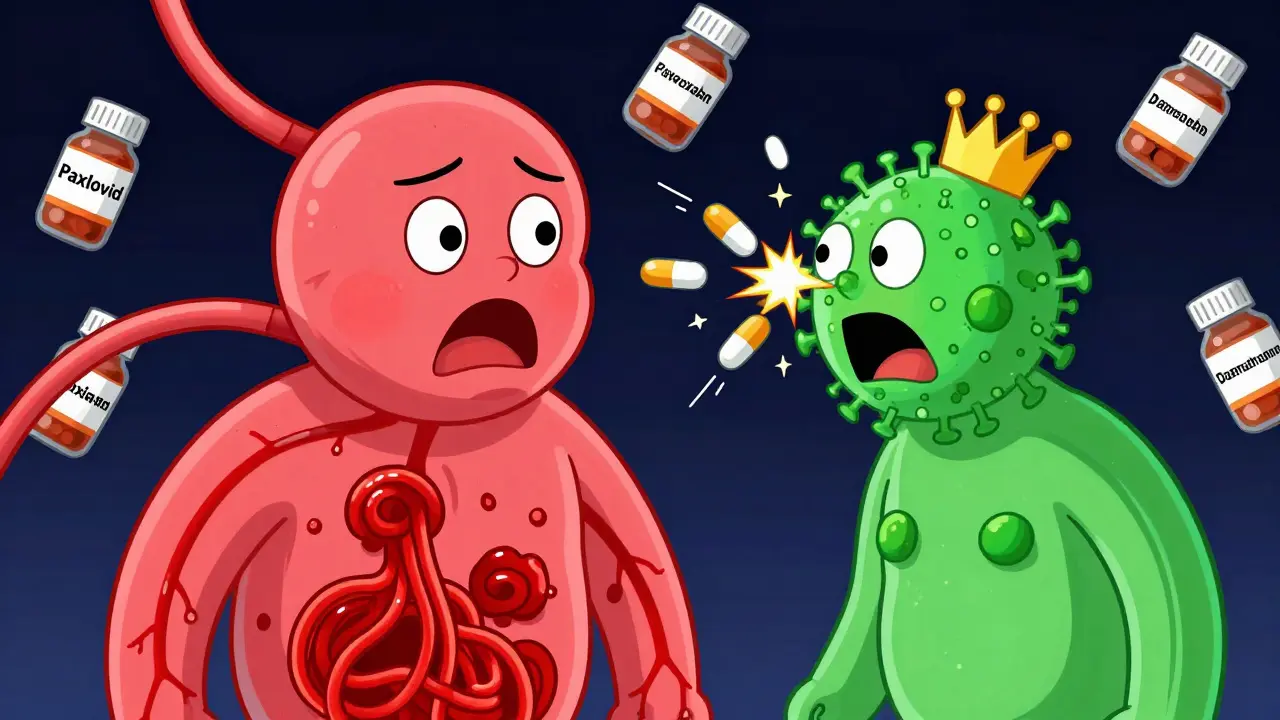
Paxlovid, the antiviral combo of nirmatrelvir and ritonavir, is highly effective at reducing hospitalization in high-risk patients. But ritonavir? It’s a powerful inhibitor of CYP3A4 and P-glycoprotein - two key systems your body uses to break down drugs like apixaban, rivaroxaban, and dabigatran. When you take Paxlovid, these enzymes get shut down. Your blood thinner doesn’t get cleared. It builds up. Levels can spike 3 to 5 times higher than normal.
A 2022 study in PMC9284020 followed 12 patients on DOACs who got Paxlovid or other antivirals. Every single one had dangerously high anticoagulant levels. One patient on rivaroxaban ended up in the ER with a gastrointestinal bleed after taking both. He needed two units of blood. That’s not rare. The FDA received 147 reports of major bleeding linked to Paxlovid and DOACs between January 2022 and June 2023.
On the flip side, dexamethasone - a steroid used to calm lung inflammation in severe COVID - does the opposite. It speeds up the breakdown of DOACs. One study showed it can reduce anticoagulant levels by up to 50%. That means your blood thinner stops working. You’re at risk for clots in your lungs, legs, or heart - even while you think you’re protected.
Warfarin Isn’t Safe Either - It’s Just Different
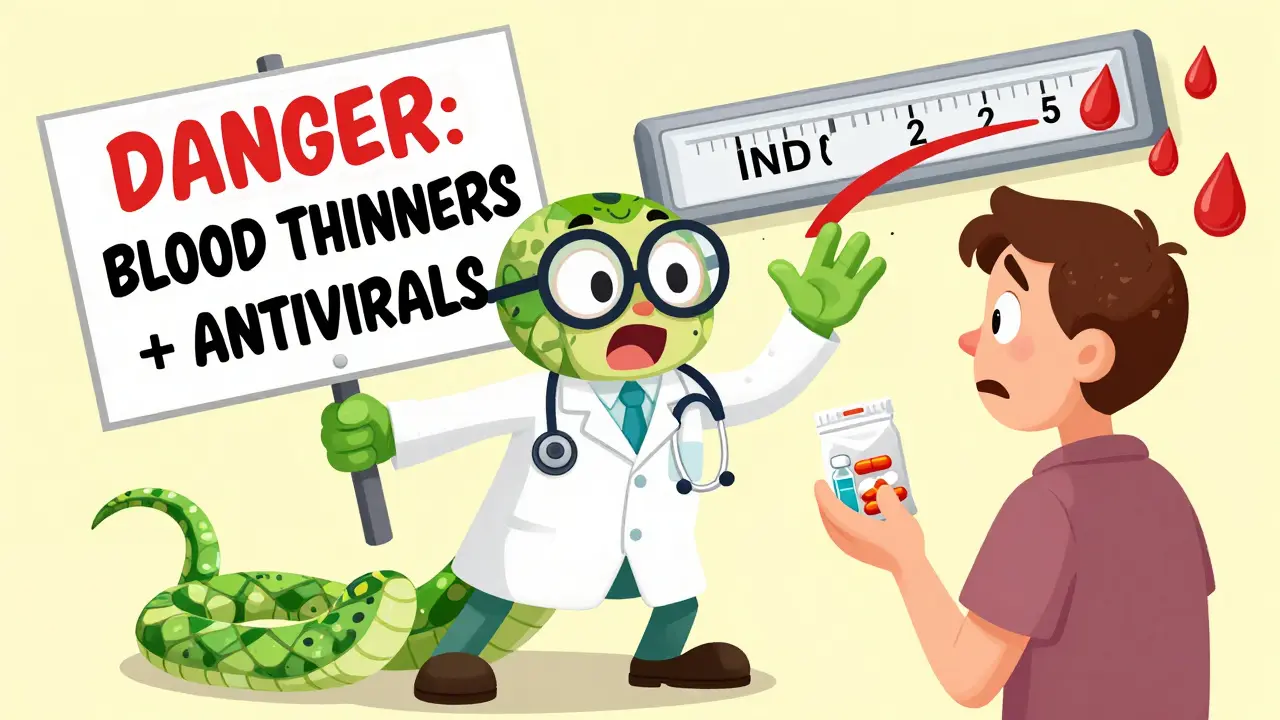
Warfarin doesn’t rely on CYP3A4 the way DOACs do, but it’s not immune. It’s metabolized by CYP2C9 and CYP1A2, and many antivirals and antibiotics interfere with those too. A 2023 case study in Frontiers in Pharmacology showed a 70-year-old man on warfarin had his INR jump from 2.5 to 3.8 after adding azvudine and dexamethasone. That’s a big deal. INR above 3.0 means bleeding risk spikes. He was lucky - he didn’t bleed. But many aren’t.
What makes warfarin tricky is that you need regular blood tests (INR) to keep it in range. During the pandemic, clinics shut down. People couldn’t get tested. One US study found the time patients spent in the therapeutic INR range dropped by 18-22% during the first year of the pandemic. That’s a direct result of missed monitoring. More people bled. More people clotted.
DOACs vs. Warfarin: Which Is Riskier During COVID?
There’s no simple answer. DOACs are easier to use - no weekly blood tests. But their interactions with antivirals are more dramatic and harder to predict. Warfarin is harder to manage, but we’ve had decades of experience adjusting it. The problem is, during a fast-moving illness like COVID-19, you don’t have time to fine-tune warfarin. You need fast, reliable answers.
Here’s what the data shows:
| Anticoagulant | Interaction with Paxlovid | Interaction with Dexamethasone | Bleeding Risk Increase | Clot Risk Increase |
|---|---|---|---|---|
| Rivaroxaban | Strong interaction - avoid or reduce dose | Reduced effectiveness - possible clot risk | Up to 15% | Up to 16.5% |
| Apixaban | Similar to rivaroxaban - hold during Paxlovid | Reduced effectiveness | Up to 14% | Up to 15% |
| Dabigatran | High risk if CrCl < 50 - avoid or reduce dose | Reduced effectiveness | Up to 13% | Up to 14% |
| Warfarin | Moderate - requires close INR monitoring | Variable - can increase or decrease INR | Up to 12% | Up to 10% |
These numbers come from a 2022 meta-analysis in JAMA Internal Medicine of over 22,000 patients. The takeaway? All anticoagulants carry risk during COVID-19. But DOACs are more vulnerable to sudden, dramatic shifts. Warfarin changes more slowly - but only if you’re testing regularly.
What Should You Actually Do?
There’s no one-size-fits-all plan. But here’s what top hospitals and pharmacists are doing right now:
- Check your anticoagulant type. If you’re on a DOAC (apixaban, rivaroxaban, dabigatran, edoxaban), you need to act before starting Paxlovid.
- For rivaroxaban or apixaban: Hold the dose for the full 5 days of Paxlovid. Restart 2 days after the last dose. If you’re at high risk for clots (like if you’ve had a prior DVT or have a CHA₂DS₂-VASc score of 3 or higher), ask your doctor about bridging with enoxaparin (a daily injection) during those 5 days.
- For dabigatran: If your kidney function is normal (CrCl ≥50 mL/min), you can take it, but reduce the dose to 75 mg twice daily and space it at least 12 hours apart from Paxlovid. If your kidneys are weak (CrCl 15-30 mL/min), avoid it entirely.
- For warfarin: Keep taking it, but get your INR checked every 2-3 days during Paxlovid treatment. Dexamethasone can make your INR go up or down - unpredictably.
- Never adjust your dose on your own. Even if you feel fine, the drug levels in your blood can be dangerously high or low without symptoms.
One pharmacist in Minnesota shared a success story: a 78-year-old woman on rivaroxaban for atrial fibrillation. She got COVID, started Paxlovid, and her doctor switched her to enoxaparin for 5 days. She didn’t bleed. She didn’t clot. She went home without complications. That’s the gold standard.

Why This Is So Hard for Doctors and Pharmacists
Guidelines aren’t consistent. The U.S. says avoid dabigatran with Paxlovid if kidney function is below 50. Europe says it’s okay if you lower the dose. The FDA says hold DOACs. The ISTH says avoid them entirely. That confusion means patients get mixed advice.
Community pharmacists are on the front lines. A 2022 survey by the American Pharmacists Association found 63% of outpatient pharmacists saw at least one anticoagulant-COVID interaction every month. Dabigatran and Paxlovid made up 42% of those cases. Many patients didn’t even know they were on a risky combo.
And it’s not just pills. Many patients take OTC meds - like ibuprofen or garlic supplements - that also thin the blood. Add those in, and the risk multiplies. One Reddit user described how his father, on warfarin, took turmeric capsules during COVID and ended up in the ER with a brain bleed. He didn’t tell his doctor.
What’s Changing Now - And What’s Next
The FDA and NIH updated their guidelines in late 2023. Now, for patients with high clot risk, therapeutic enoxaparin is recommended during Paxlovid treatment. That’s a big shift - it means doctors are starting to treat this like a known, manageable problem, not a mystery.
Pharmaceutical companies are listening too. Pfizer’s next antiviral, PF-07817883, is in Phase 2 trials and doesn’t strongly inhibit CYP3A4. If it works, it could eliminate most of these interactions within the next few years.
Meanwhile, new tools are helping. The Liverpool COVID-19 Drug Interactions website has processed over 1.2 million queries since 2020. It’s free, updated daily, and used by clinicians worldwide. If you’re on a blood thinner and prescribed an antiviral, type both drugs in - it’ll tell you if it’s safe.
And AI is coming. A 2023 study in Nature Medicine built a machine learning model that predicts interaction severity with 89.4% accuracy. It’s not in clinics yet - but it will be.
What You Need to Do Right Now
If you’re on a blood thinner:
- Keep a list of every medication you take - including supplements and OTC drugs.
- Know your kidney function (CrCl). Ask your doctor for this number.
- Never start a new antiviral without checking for interactions - even if it’s over-the-counter.
- Call your pharmacist before taking Paxlovid or any antiviral. They’re trained for this.
- If you’re on warfarin, get your INR checked more often during illness.
- If you’re on a DOAC and get COVID, assume your medication is unsafe until proven otherwise.
These aren’t just precautions. They’re life-saving steps. The risk isn’t theoretical. It’s real. And it’s happening right now.
Can I take ibuprofen with my blood thinner during COVID-19?
No - not without talking to your doctor. Ibuprofen and other NSAIDs can increase bleeding risk when combined with anticoagulants. During a viral infection, your platelets are already affected. Adding ibuprofen can push you into dangerous bleeding territory. Use acetaminophen (Tylenol) instead for fever or pain, and only if your liver is healthy.
What if I miss a dose of my blood thinner during Paxlovid treatment?
Don’t double up. If you’re holding your DOAC for 5 days during Paxlovid, just restart it 2 days after your last Paxlovid dose. Missing one dose won’t cause a clot - but taking too much after can cause bleeding. Follow your doctor’s plan exactly.
Do I need to stop my blood thinner if I get a mild case of COVID-19 at home?
Not necessarily. If you’re not hospitalized and not taking antivirals like Paxlovid, you usually don’t need to change your dose. But if you’re on dexamethasone (even a short course), your DOAC might become less effective. Talk to your doctor - don’t assume it’s safe.
How do I know if my blood thinner is working too well?
Signs include unusual bruising, nosebleeds that won’t stop, blood in urine or stool, severe headaches, or sudden weakness. If you’re on warfarin, an INR above 4.0 is dangerous. For DOACs, there’s no simple test - but if you feel off, get checked. Anti-Xa levels can be measured in hospitals if needed.
Is there a safer blood thinner to use during COVID-19?
Not really - but enoxaparin (Lovenox) is the safest option during antiviral treatment. It’s an injection, doesn’t interact with CYP3A4, and can be used as a bridge while you’re on Paxlovid. Many hospitals now use it for high-risk patients. It’s not perfect - you need injections - but it’s the most predictable choice during drug interactions.


Post A Comment