
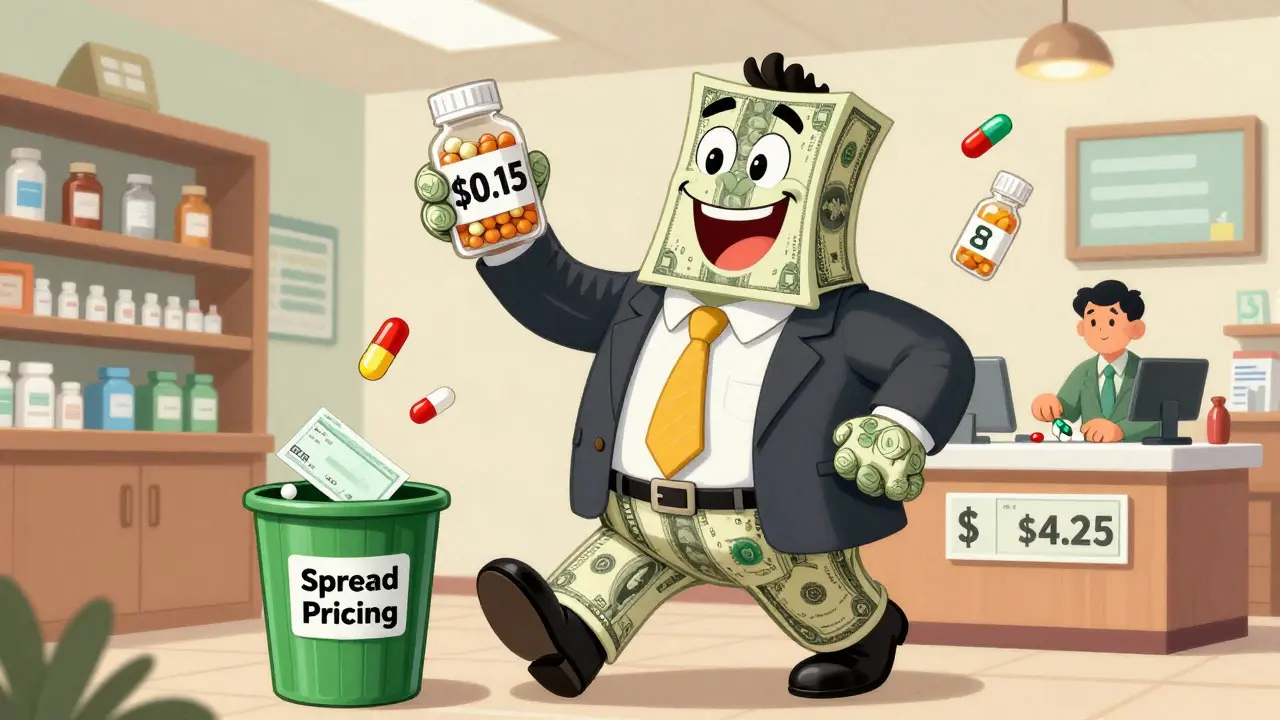
When you fill a prescription for a generic drug-say, lisinopril for high blood pressure or metformin for diabetes-you might assume the insurance company pays a small, straightforward amount. After all, generics are cheap, right? But what you see on your receipt-$5, $10, maybe $0 if you’re lucky-isn’t the full story. Behind the scenes, something much more complicated is happening. Insurance doesn’t pay what you think it does for generics, and the rebate system, which works so visibly for brand-name drugs, barely exists here. Instead, hidden fees, spread pricing, and opaque contracts are quietly shaping what your plan really spends.
Generics Don’t Get Rebates-Here’s Why
Unlike brand-name drugs, which often come with 30% to 70% rebates negotiated by pharmacy benefit managers (PBMs), generic drugs operate on a completely different model. Why? Because there’s no need. Generics are made by dozens, sometimes hundreds, of manufacturers. The market is flooded with identical pills. Competition drives the price down naturally. There’s no single company with enough power to demand a premium or offer a big rebate to get on a formulary. The Blue Cross Blue Shield of Kansas put it simply: "Generics typically don’t offer rebates." That’s not an exception-it’s the rule. The U.S. Government Accountability Office found that when rebates do occur for generics, they’re usually between 2% and 5% of the list price. Compare that to brand-name drugs, where rebates can be ten times higher. So if you’re wondering why your insurer doesn’t seem to be "saving money" on generics through rebates, the answer is: they’re not trying to. They’re saving money by paying less upfront.What Insurance Actually Pays: The Spread Pricing Trap
Here’s where things get murky. Since there’s no rebate system, PBMs have built another way to profit: spread pricing. This is the gap between what the insurer thinks it’s paying the pharmacy and what it actually pays. Let’s say your plan’s contract says the insurer will reimburse the pharmacy $8.50 for a 30-day supply of generic atorvastatin. That’s the number you see on your Explanation of Benefits. But here’s the catch: the pharmacy only paid $4.25 to buy those pills from a wholesaler. The PBM pockets the $4.25 difference. That’s spread pricing. And it’s not disclosed to you, your employer, or even your doctor. The Department of Health and Human Services reported in 2022 that the average spread on generic prescriptions was $4.73 per fill. Multiply that by millions of fills a year, and you’re looking at billions in hidden revenue for PBMs. Your insurance company thinks it’s paying $8.50. The pharmacy gets $4.25. The PBM keeps $4.25. And you? You’re still paying your $5 copay. No one tells you the real cost.Why This Hurts You-Even If Your Copay Is Low
You might think, "If my copay is $0 or $5, why should I care?" Because the system is rigged to discourage the cheapest options. PBMs have a financial incentive to favor brand-name drugs-even when generics are available. Why? Because brand-name drugs bring in big rebates. If a PBM can get a 60% rebate on a $500 brand-name drug, it makes more money than if it pushes a $0.15 generic. So, guess what happens? Formularies get manipulated. The generic gets moved to a higher tier. Prior authorization is required. Or worse: it’s left off the formulary entirely. A case study from the Midwest Manufacturers Association showed a PBM excluding a $0.15 generic blood pressure pill in favor of a $5 brand-name version with a 60% rebate. The net cost to the plan? Higher. The patient’s copay? Higher. The PBM’s profit? Bigger. And no one knew until someone dug into the contract. This isn’t rare. A 2023 survey by the National Business Group on Health found that 68% of large employers couldn’t figure out what they were actually paying for generic drugs. That’s not a glitch-it’s by design.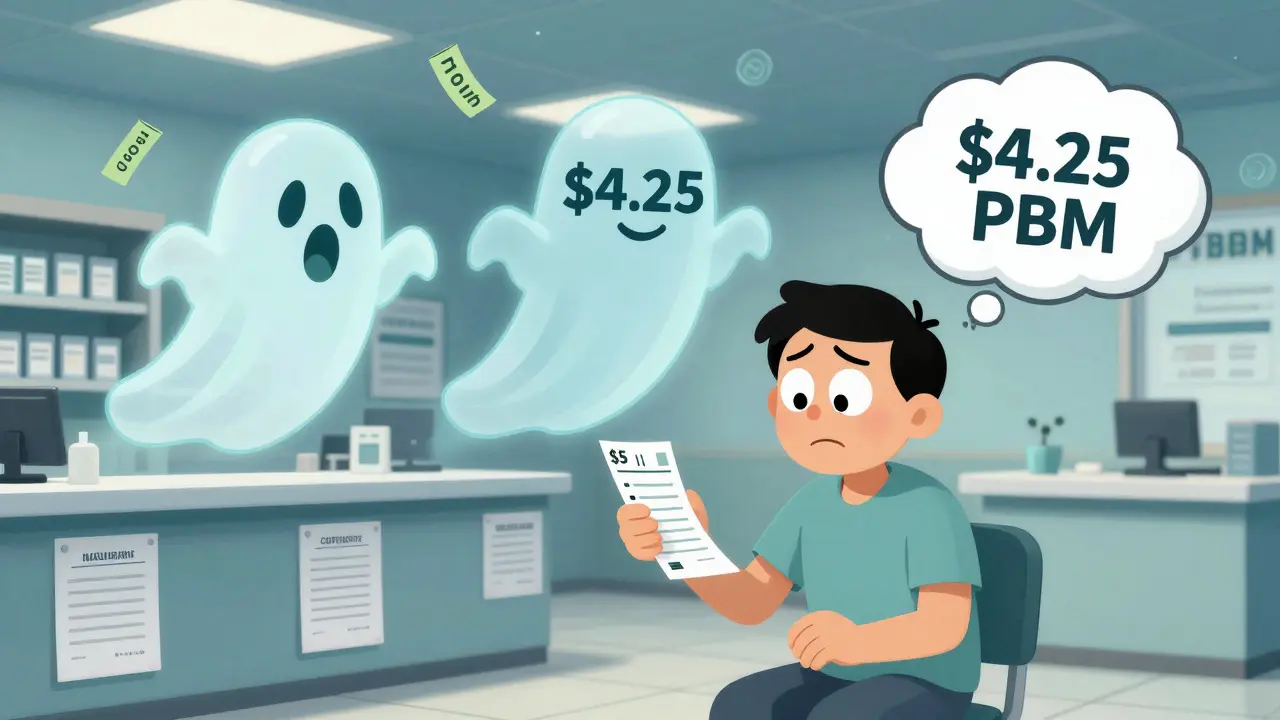
Who Controls This System? The Big Three PBMs
Three companies-CVS Caremark, Express Scripts, and OptumRx-control about 80% of the PBM market in the U.S. They negotiate with pharmacies, set reimbursement rates, and decide which drugs are covered and at what cost. They’re not insurers. They’re not pharmacies. They’re middlemen with a profit model built on opacity. These companies don’t just negotiate rebates. They control the entire pricing chain. They set the Average Wholesale Price (AWP), a number that’s been disconnected from real market prices for decades. They use AWP as the baseline to calculate reimbursements, even though no one actually pays that price. It’s a fiction that lets them hide spreads. And because they’re so dominant, employers and small insurers have little leverage. If you’re not a Fortune 500 company with a team of benefits lawyers, you’re at their mercy.What’s Changing? Transparency Is Coming
There’s pressure building. The No Surprises Act of 2020 forced some disclosure, but it didn’t touch spread pricing on generics. The Inflation Reduction Act of 2022 excluded generics from Medicare’s new price negotiation program-because lawmakers recognized they’re already cheap. But that doesn’t mean the system is fair. In 2024, the Biden administration ordered the Department of Health and Human Services to investigate practices that limit generic use. The Employee Benefit Research Institute found that 42% of large employers had switched to pass-through pricing by 2024-meaning PBMs charge a flat administrative fee and don’t keep the spread. That’s the right model. And by 2026, experts predict new laws will require PBMs to disclose the actual acquisition cost of every generic drug. That means employers and insurers will finally know what the pills cost to buy. No more hiding. No more spreads. Just real pricing.
What You Can Do
If you’re an individual: ask your pharmacy what the cash price is. Sometimes, paying out of pocket for a generic is cheaper than using insurance-especially if your copay is high and your plan uses spread pricing. If you’re an employer or plan sponsor: demand pass-through pricing. Don’t accept vague contracts. Ask for the Wholesale Acquisition Cost (WAC) of your top 20 generic drugs. If your PBM won’t show you, find one that will. If you’re a patient: know that your copay doesn’t reflect the true cost. If a generic is suddenly harder to get, ask why. Is it really medical necessity-or is it profit?Why This Matters Beyond Your Prescription
The generic drug market is worth over $75 billion a year in the U.S. It accounts for 90% of all prescriptions filled. Yet it makes up only 23% of total drug spending. That’s the power of competition. But if PBMs are allowed to game the system with hidden fees and formulary manipulation, that power gets diluted. The savings vanish. The cost shifts to employers, to Medicare, to taxpayers. And ultimately, to you. The system was meant to make drugs affordable. Instead, it made the middlemen rich. The fix isn’t complicated. It’s transparency. It’s accountability. And it’s finally starting to happen.Do generic drugs ever get rebates from manufacturers?
Rarely, and if they do, the rebates are tiny-usually between 2% and 5% of the list price. That’s because generics are made by many companies, and competition keeps prices low. There’s no need for big rebates like those seen with brand-name drugs, which can be 30% to 70% of the price. Most of the savings from generics come from low upfront prices, not post-sale rebates.
What is spread pricing, and how does it affect what insurance pays for generics?
Spread pricing is when a pharmacy benefit manager (PBM) charges an insurance plan one price for a generic drug but pays the pharmacy a lower price, keeping the difference as profit. For example, the plan might be billed $8.50, the pharmacy gets $4.25, and the PBM keeps $4.25. This money never reaches the patient or the pharmacy. It’s hidden in the contract, and most people don’t know it’s happening-until they dig into their plan’s details.
Why do PBMs favor brand-name drugs over generics?
PBMs make more money from brand-name drugs because those manufacturers pay large rebates-sometimes 60% or more-to get their drugs placed on preferred formularies. Even if a generic is cheaper, if the brand-name drug brings in a bigger rebate, the PBM has a financial reason to push the brand. This can lead to generics being moved to higher cost tiers or even excluded from coverage, forcing patients to pay more or fight for access.
Can I save money by paying cash for a generic instead of using insurance?
Yes, sometimes. Because of spread pricing and high copays, the cash price at pharmacies like Walmart, Costco, or CVS can be lower than your insurance copay. For common generics like metformin, lisinopril, or atorvastatin, cash prices can be as low as $4 to $10 for a 30-day supply. Always ask the pharmacist: "What’s your cash price?" before using insurance.
Is there any movement to fix this system?
Yes. In 2024, 42% of large employers switched to "pass-through" pricing, where PBMs charge a flat fee instead of keeping the spread. The Biden administration ordered a review of practices that block generic use, and by 2026, new federal rules are expected to require PBMs to disclose the actual cost they pay for every generic drug. Transparency is coming-and it’s the only way to fix the system.


Post A Comment