
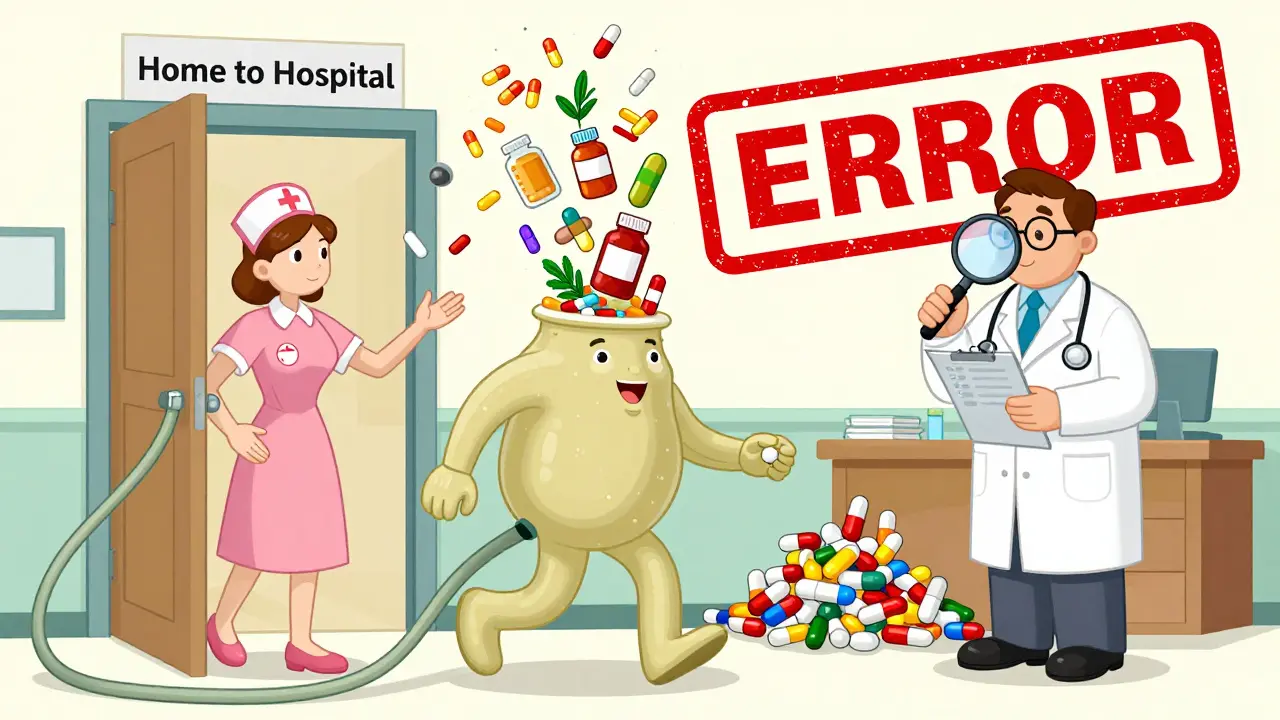
When a patient moves from one care setting to another-whether it’s from home to the hospital, from the ER to a ward, or from hospital to a nursing home-their medication list should move with them. But too often, it doesn’t. That’s where medication reconciliation comes in. It’s not just a form to fill out. It’s a safety checkpoint that can prevent hospital readmissions, dangerous drug interactions, and even death.
Why Medication Reconciliation Matters
Every year, around 6.5% of hospital admissions are caused by adverse drug events. That’s not random. It’s often because someone was given the wrong dose, a duplicate drug, or a medication they were already stopping. In fact, research shows that 50-70% of patients experience a medication error during a care transition. And 20-30% of those errors lead to harm. The problem isn’t usually bad intent. It’s fragmented systems. A patient might be taking five prescriptions, three over-the-counter pills, and a herbal supplement their doctor never knew about. When they’re admitted, the nurse asks, "What meds are you on?" The patient says, "I take the blue one in the morning, the white one at night, and that green bottle from the store." That’s not enough. That’s where reconciliation steps in.The Five Steps of Medication Reconciliation
This isn’t guesswork. It’s a structured five-step process used by hospitals, clinics, and pharmacies across the U.S. and beyond:- Develop a complete list of current medications. This includes prescriptions, OTC drugs, vitamins, supplements, herbal remedies, and even medications taken irregularly. It’s called the Best Possible Medication History (BPMH). You don’t just ask the patient-you check their pharmacy records, call their primary care provider, and talk to family members.
- Create a list of medications to be prescribed. This is what the care team plans to give during this admission or transition. It’s based on diagnosis, lab results, and clinical judgment.
- Compare the two lists. Look for discrepancies: missing drugs, wrong doses, duplicate therapies, or interactions. For example, a patient might be on two different blood thinners-something that could cause internal bleeding.
- Make clinical decisions. Not every discrepancy means a change. Sometimes, the patient was taking a drug incorrectly. Sometimes, a duplicate was intentional. A pharmacist or provider reviews each mismatch and decides what to keep, stop, or adjust.
- Communicate the new list. The updated list must go to the patient, their caregivers, and every provider involved. A discharge summary without a full medication list is a ticking time bomb.
Who Does It Best? Pharmacists Lead the Way
Nurses and doctors are busy. But pharmacists? They’re trained specifically for this. The American Society of Health-System Pharmacists says pharmacists are the medication experts-and they’re right. Studies show that when pharmacists lead reconciliation, medication errors drop by 47% compared to nurse-only models. One hospital in Minnesota saw a 67% reduction in medication errors after assigning pharmacists to every admission and discharge. They didn’t just do paperwork. They sat with patients, reviewed pill bottles, called pharmacies, and followed up after discharge. That’s the difference.Technology Helps-But It’s Not Enough
Electronic health records (EHRs) like Epic and Cerner have reconciliation tools built in. Some platforms, like MedsReview, claim 37% higher accuracy than standard EHRs. Surescripts connects 90% of U.S. pharmacies, so providers can pull real-time medication histories. But here’s the catch: 18-22% of pharmacy data is still missing. And 43% of discharge summaries don’t include a complete medication list. Why? Because the system doesn’t force it. If reconciliation is optional, it gets skipped. A hospital pharmacist on Reddit shared: "It takes 45-60 minutes per patient to reconcile properly. Our EHR makes it clunky. We work around it. And patients pay the price."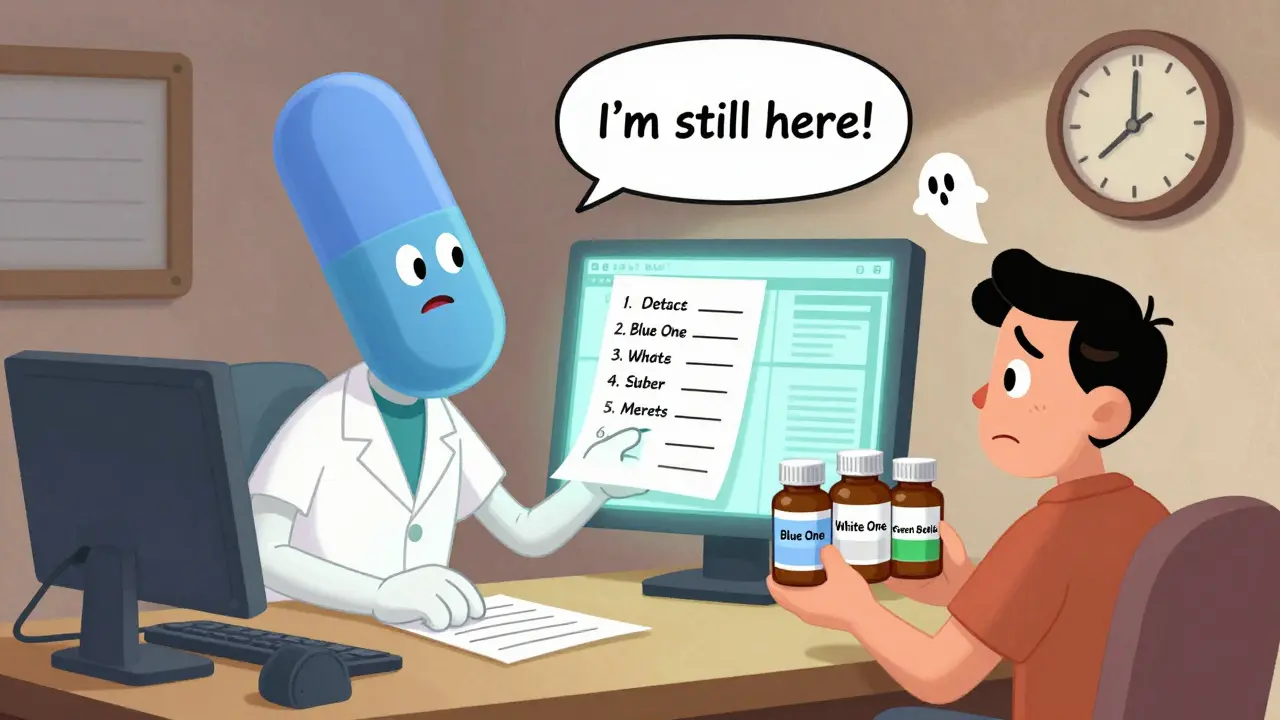
The Human Factor: Patients Don’t Know Their Own Meds
In one study, 40-50% of elderly patients couldn’t name even half their medications. They didn’t know why they were taking them. They didn’t know the doses. One patient said she took "the red pill for my heart"-but she’d been on three different heart medications in the last year. That’s why the Best Possible Medication History (BPMH) requires at least two independent sources. A patient’s word alone is wrong 42% of the time. Some hospitals now give patients medication diaries. Those who used them improved reconciliation accuracy by 27%. Simple. Low-tech. Effective.What Happens When You Skip It?
In 2020, a 72-year-old man was discharged after heart surgery. His discharge summary said he was on warfarin. But his home meds included rivaroxaban. The hospital didn’t reconcile the two. He went home, took both, and bled internally. He was readmitted two days later. He survived. But he didn’t have to. This isn’t rare. Sixty-one percent of patients feel confused about their meds after discharge. Twenty-eight percent change or stop their meds incorrectly in the first week. That’s not noncompliance. That’s poor communication.Regulations and Incentives Are Pushing Change
Medicare and Medicaid now tie reimbursement to reconciliation performance. The CMS Hospital Readmissions Reduction Program penalizes hospitals with too many readmissions. In 2023, the average penalty was 0.64% of Medicare payments. For a large hospital, that’s millions. The 21st Century Cures Act requires health systems to share medication data across platforms. The ONC’s USCDI Version 4, launched in January 2023, now includes standardized reconciliation data elements. That means better communication between hospitals, clinics, and pharmacies. Even the Joint Commission updated its National Patient Safety Goal in 2023 to require reconciliation of traditional AND alternative medicines. Because 52% of patients use herbs or supplements-and most providers never ask.
Real Results: What Works
Mayo Clinic Rochester’s pharmacist-led program reduced 30-day readmissions by 18% and prevented 1,247 adverse drug events per year. Johns Hopkins cut medication discrepancies by 72% in 18 months by hiring dedicated reconciliation technicians and building a standard workflow. They didn’t buy fancy software. They didn’t hire more doctors. They gave pharmacists time, training, and authority.Where We’re Falling Short
Only 56% of hospitals have fully integrated reconciliation into their clinical workflow. Sixty-three percent of providers say they don’t have enough time. Forty-one percent of nurses admit they sometimes skip reconciliation because they’re rushed. And here’s the quiet crisis: 61% of hospitals run reconciliation programs at a net loss. Medicare doesn’t pay enough for the time it takes. No one bills for it. So it gets cut.What Needs to Change
We need to stop treating reconciliation as a paperwork chore. It’s a life-saving process. Here’s how to fix it:- Assign pharmacists to every transition of care-not just as an afterthought.
- Give them 15-20 minutes per admission and 10-15 minutes per discharge. No exceptions.
- Use patient medication diaries. They’re cheap, simple, and proven.
- Require complete medication lists on all discharge summaries. No exceptions.
- Train staff on how to ask better questions: "What does this pill do?" instead of "What meds are you on?"
Technology will keep evolving. AI tools like Google’s DeepMind Health can predict discrepancies with 89% accuracy. But they still need a human to confirm. Because medicine isn’t about algorithms. It’s about people.
Medication reconciliation isn’t about checking boxes. It’s about making sure the right drug gets to the right person at the right time. Every time.
What is the difference between medication reconciliation and a medication review?
Medication reconciliation is a structured process done only during care transitions-like hospital admission, transfer, or discharge. It focuses on catching errors in medication lists. A medication review, on the other hand, is a general assessment done during routine visits to evaluate whether a patient’s current meds are still working. Reconciliation is about safety; reviews are about effectiveness.
Who is responsible for performing medication reconciliation?
While nurses, doctors, and even patients can contribute information, pharmacists are the gold standard for leading the process. They have the training to identify drug interactions, dosing errors, and therapeutic duplications. The American Society of Health-System Pharmacists states that pharmacists’ expertise is essential to safe transitions of care. In practice, a pharmacist-led team with support from pharmacy technicians delivers the best results.
Why is patient self-reporting unreliable for medication lists?
Studies show that relying only on what patients say results in errors in 42% of cases. Patients forget names, doses, or reasons for taking meds. They may not realize supplements or OTC drugs are "medications." Elderly patients or those with cognitive issues struggle even more. That’s why the Best Possible Medication History (BPMH) requires at least two independent sources-like pharmacy records, family input, or electronic health records-to verify what’s being taken.
How do electronic health records (EHRs) help with reconciliation?
EHRs can pull medication data from pharmacies via systems like Surescripts, flag potential drug interactions, and auto-generate comparison lists. Tools like Epic’s Transition of Care module cut reconciliation time by 22%. But they’re only as good as the data they receive. Gaps in pharmacy records, inconsistent documentation, and poor user input mean EHRs alone can’t prevent errors. They’re tools-not replacements-for human judgment.
What happens if a hospital doesn’t perform medication reconciliation?
Without reconciliation, patients face higher risks of adverse drug events, hospital readmissions, and even death. Financially, hospitals can be penalized under Medicare’s Hospital Readmissions Reduction Program (HRRP), losing up to 3% of Medicare payments for excessive readmissions. Regulatory bodies like The Joint Commission may also cite non-compliance. And critically, patients lose trust when they’re given the wrong meds after discharge-leading to poor adherence and worse outcomes.


Post A Comment