
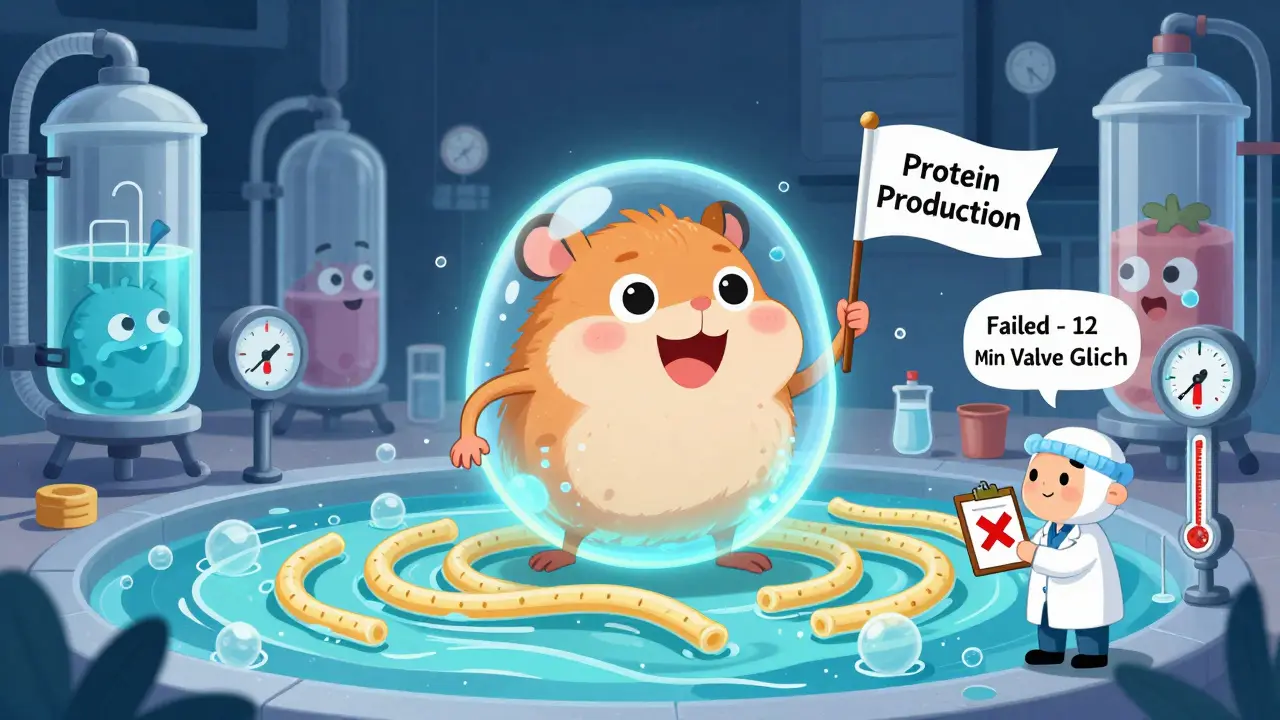
When you take a pill for high blood pressure or an infection, you expect every tablet to be exactly the same. That’s because most drugs are made through chemical reactions in a lab - like baking a cake from a recipe. But biologic drugs? They’re not made that way. They’re grown. In living cells. And that changes everything.
What Makes Biologics Different
Biologic drugs are made from living organisms - bacteria, yeast, or mammalian cells engineered to produce proteins that treat serious diseases. Think of them as tiny biological machines built inside a petri dish. The first one approved was human insulin in 1982. Today, they’re used for cancer, rheumatoid arthritis, diabetes, and rare immune disorders. Drugs like Humira and Ozempic are biologics. They’re not small molecules you can dissolve and mix. They’re huge, complex proteins - up to 1,000 times bigger than a typical pill’s active ingredient.
This size and structure matter. A small molecule drug like aspirin has one fixed chemical formula. If you make it in China or Canada, it’s identical. But a biologic? Even if you use the same cell line, same equipment, same process, each batch has tiny differences. Not because someone made a mistake. Because biology is messy. Cells don’t follow instructions perfectly. They tweak their own behavior. That’s not a flaw - it’s how life works.
Why You Can’t Just Copy Them
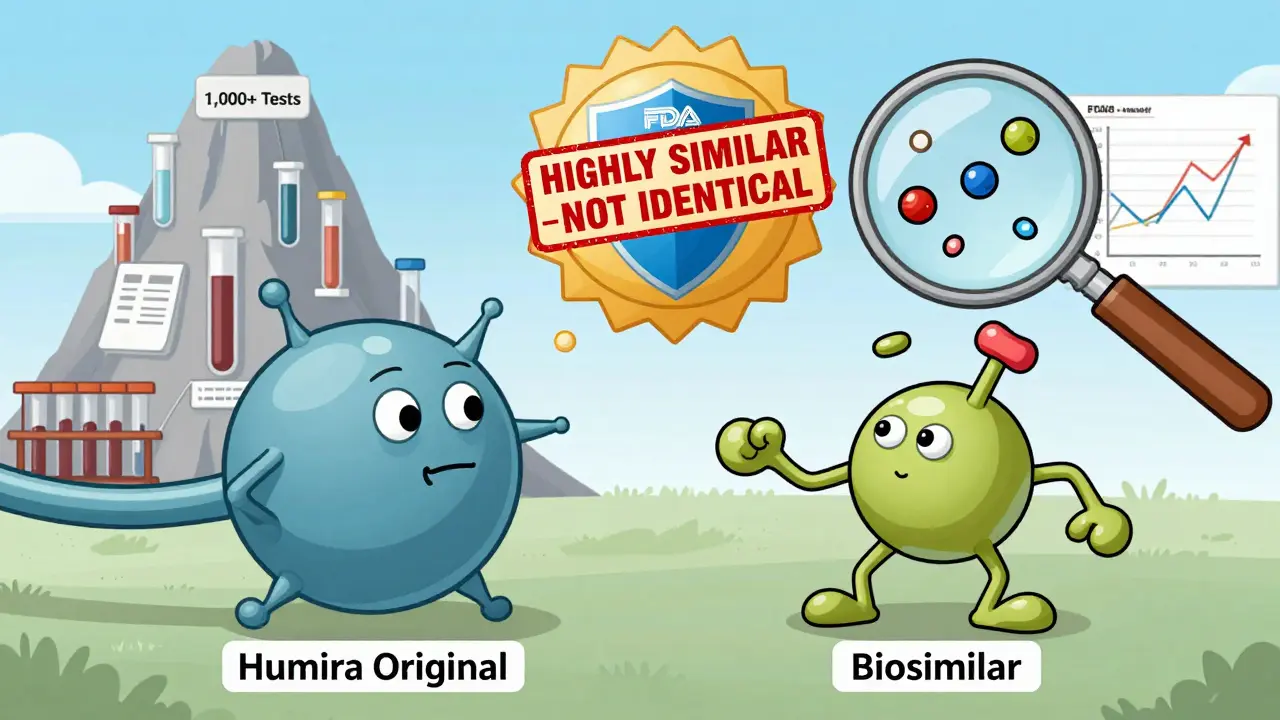
That’s why you don’t get “generic” biologics. You get biosimilars. And they’re not the same thing.
A generic version of a small molecule drug just needs to prove it delivers the same amount of the same chemical into your bloodstream. Simple. Fast. Cheap.
A biosimilar? It has to prove it’s highly similar - not identical - to the original biologic. The FDA requires thousands of tests: comparing protein folding, sugar attachments, charge patterns, impurity profiles. Even then, they can’t test every single part of the molecule. Current science can only analyze about 60-70% of a typical monoclonal antibody’s structure. The rest? We infer it. We assume it’s close enough.
And here’s the kicker: the manufacturing process itself becomes part of the drug. If you change the temperature of a bioreactor by half a degree, or the oxygen level for a few hours, the final product changes. Not dramatically - but enough that regulators demand proof it won’t affect safety or effectiveness. That’s why a biosimilar isn’t a copy. It’s a very, very close relative.
The Manufacturing Nightmare
Building a biologic isn’t like assembling a smartphone. It’s more like raising a baby - and every baby has different needs.
The whole process takes 3 to 6 months. Compare that to a small molecule drug, which might take 3 to 6 weeks. Here’s what happens:
- You start with a genetically modified cell - say, a hamster ovary cell - that’s been programmed to make a specific protein.
- You put millions of these cells into a bioreactor, the size of a small car, filled with nutrient-rich broth. Temperature? 36-37°C. pH? 7.0-7.4. Oxygen? Precisely controlled. One wrong setting, and the cells die or make the wrong protein.
- This stage lasts 10-14 days. You monitor cell health constantly. If viability drops below 95%, the whole batch is scrapped.
- Then comes purification. The protein must be pulled out of the cell soup. Protein A chromatography removes 95-98% of impurities. Viral filters catch any contaminants. Ultrafiltration concentrates the solution.
- Finally, it’s mixed into a stable buffer, filled into vials, and tested again. Every single batch. Every single time.
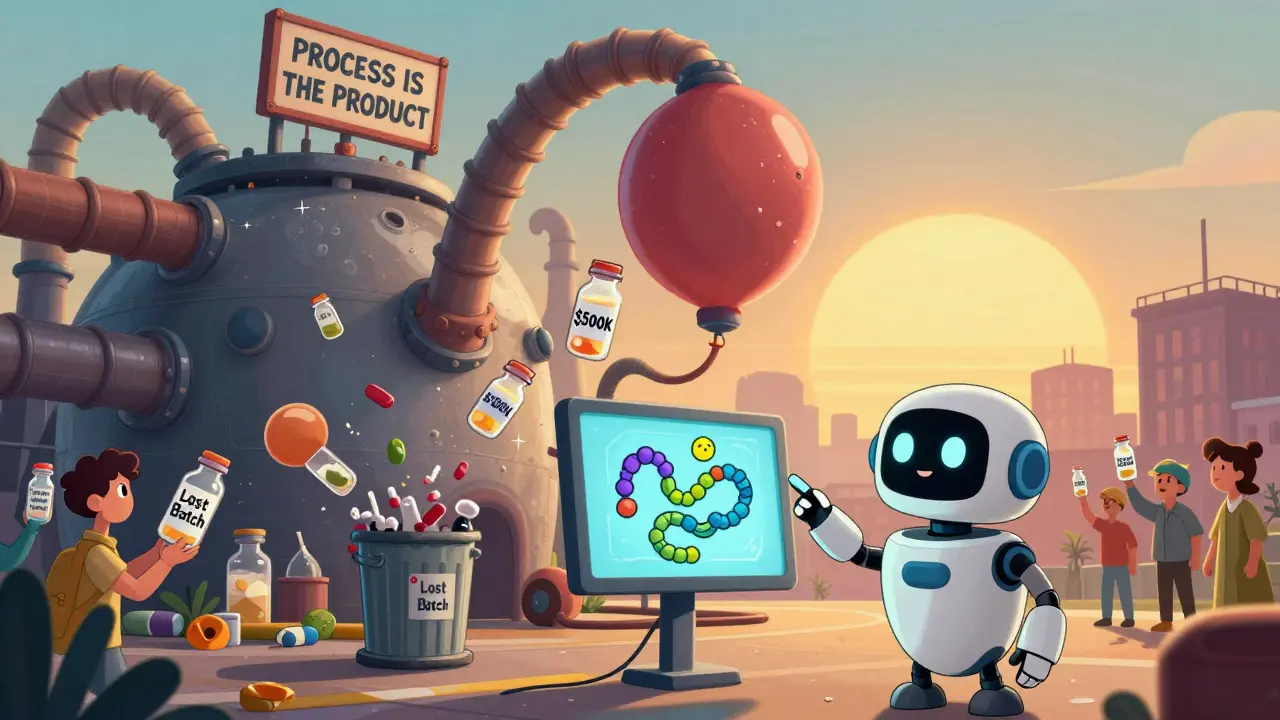
Quality control makes up 30-40% of the total cost. For a regular pill? It’s 5-10%. That’s why a single failed batch can cost over $500,000. One Reddit post from a biomanufacturing engineer described losing a $1.2 million run because a pump valve stuck for 12 minutes. No one saw it coming. The cells started producing a slightly different protein. The whole lot was destroyed.
Why Biosimilars Are Still Hard to Make
Companies trying to make biosimilars don’t just copy the original drug. They reverse-engineer the whole process - and even then, they can’t be sure they’ve got it right.
The original manufacturer doesn’t share its exact recipe. It’s proprietary. So biosimilar makers have to guess. They test, tweak, retest. Sometimes it takes years. One senior engineer at Amgen said switching from a 2,000-liter bioreactor to a 15,000-liter one took 17 months and $22 million in lost revenue. Why? Because scaling up changes how cells behave. It’s not linear. It’s unpredictable.
And regulators don’t cut corners. The FDA requires full analytical data, animal studies, and even clinical trials to prove biosimilarity. That’s why biosimilars cost 15-35% less than the original - not 80% like generics. They’re still expensive to develop. But they’re still cheaper than paying full price for the brand-name drug.
What’s Changing in the Industry
Manufacturers are trying to fix the mess. Single-use bioreactors - plastic bags instead of stainless steel tanks - have cut contamination risks by 60%. AI is being used to predict how small changes in temperature or nutrient flow will affect the final product. Continuous manufacturing, where the process runs nonstop instead of in batches, is now used in 15% of new facilities.
But the core problem remains: we can’t fully characterize what we make. We can’t see every twist and turn in a protein. We can’t guarantee two batches are 100% identical. And we probably never will.
That’s why experts say: “The process is the product.” You can’t separate the drug from how it was made. A biosimilar isn’t a copy. It’s a new version of the same idea - made with the same goal, but under different conditions. And that’s okay. As long as it works.
The Bigger Picture
Biologics now make up 42% of global drug sales. That number is expected to hit 52% by 2028. More people need them. More diseases are being treated with them. But they’re not cheap. They’re not easy. And they can’t be copied like aspirin.
Biosimilars are the compromise. They bring down prices. They expand access. But they’re not generics. They’re something new - and more complicated. The system isn’t perfect. But it’s the best we have.
Next time you hear someone say, “Why can’t we just make a cheaper version?” - now you know. It’s not about patents. It’s about biology. And biology doesn’t do copies. It does variations. And sometimes, those variations are exactly what we need.
Why can’t biologic drugs have generics like regular pills?
Biologics are made from living cells, not through chemical synthesis. Their structure is too complex and variable to be exactly replicated. Even tiny changes in temperature, nutrients, or cell behavior during production alter the final product. Generics require identical molecules - which is impossible with biologics. That’s why we use biosimilars instead: highly similar, but not identical, versions.
Are biosimilars as safe and effective as the original biologic?
Yes. Regulatory agencies like the FDA and EMA require biosimilars to undergo extensive testing - including analytical studies, animal trials, and clinical trials - to prove they work the same way with no meaningful difference in safety or effectiveness. Thousands of patients have used biosimilars worldwide with outcomes matching the original drugs.
Why is biologics manufacturing so expensive?
It takes 3-6 months to produce a single batch, requires highly controlled environments (cleanrooms, precise bioreactors), and involves 30-40% quality control costs. Failure rates are 10-15%, and even minor process changes can ruin an entire batch worth hundreds of thousands of dollars. The infrastructure alone - from cell lines to purification systems - costs $100 million to $500 million to set up.
Can biosimilars be switched with the original biologic without risk?
Yes. Regulatory agencies approve biosimilars for interchangeable use - meaning a pharmacist can substitute them without consulting the doctor. This is based on evidence that switching between the original and biosimilar doesn’t affect outcomes. Real-world data from Europe and the U.S. show no increase in adverse events when patients switch.
What’s the difference between a biosimilar and a generic drug?
A generic is an exact chemical copy of a small molecule drug - same structure, same ingredients. A biosimilar is a highly similar version of a complex biologic - same function, but not identical structure. Generics require minimal testing. Biosimilars require thousands of tests across chemistry, biology, and clinical studies. That’s why biosimilars cost more to develop and are priced higher than generics.


Post A Comment