

Immunosuppressant Treatment Risk Calculator
This tool helps determine if immunosuppressants are safe for you based on the latest evidence. Research shows no increased cancer recurrence risk for most patients, but decisions should be personalized.
For years, doctors told patients with a history of cancer to wait at least five years before starting immunosuppressants. The fear was simple: if your immune system is turned down, it might not catch cancer coming back. But that rule? It was never backed by solid evidence. Now, after analyzing data from over 24,000 patients across dozens of studies, we know better.
Why the old rule didn’t hold up
The idea that immunosuppressants cause cancer to return came from logic, not data. If the immune system kills rogue cells, then weakening it should let cancer grow, right? It sounded right. So clinics across the U.S., Europe, and Australia held off on drugs like methotrexate, azathioprine, or infliximab for five years after cancer treatment. Patients with rheumatoid arthritis, Crohn’s disease, or psoriasis suffered through flare-ups, pain, and disability while waiting - all based on a guess. Then came the studies. A 2016 meta-analysis in Gastroenterology looked at 11,702 people with autoimmune diseases who’d had cancer. It compared those on no immunosuppressants, those on anti-TNF drugs like adalimumab, those on traditional modulators like methotrexate, and those on combinations. The results? No meaningful difference in cancer recurrence rates. The group on combo therapy had the highest number - 54.5 cases per 1,000 person-years - but it wasn’t statistically different from the others. The P-value? Over 0.1. That means the difference could’ve happened by chance. Fast forward to 2024. A larger study, with nearly 25,000 patients and over 85,000 years of follow-up, confirmed it. Whether you started immunosuppressants six months after cancer treatment or six years later, your risk of recurrence didn’t change. The timing didn’t matter. The type of drug - anti-TNF, JAK inhibitors, ustekinumab, vedolizumab - didn’t matter either. Even newer biologics showed slightly lower recurrence numbers, though not enough to call it significant.What the data actually says
Let’s break it down. The key findings from the latest research:- Anti-TNF agents (infliximab, adalimumab, etanercept): no increased recurrence risk
- Traditional immunomodulators (methotrexate, azathioprine, 6-MP): no increased risk
- Newer biologics (ustekinumab, vedolizumab, JAK inhibitors): no increased risk - possibly slightly lower
- Combination therapy: higher numerical rate, but not statistically different
- Timing of restart: starting before or after 5 years makes no difference
What about specific cancers?
Not all cancers are the same. The data shows consistent results across most types - breast, lung, colon, skin (non-melanoma), prostate. But there’s one exception: melanoma. Melanoma is aggressive. It’s known to be more sensitive to immune surveillance. Some experts still advise caution here, especially if the melanoma was advanced or recently treated. The same goes for blood cancers like leukemia or lymphoma - if the cancer is active or was recently treated, restarting immunosuppressants might not be safe. But for most solid tumors that are in remission? The data says it’s fine. A 2023 Journal Watch summary put it bluntly: “Immunosuppression was not associated with cancer recurrence in patients with autoimmune diseases who had previously diagnosed cancers.” That’s the bottom line.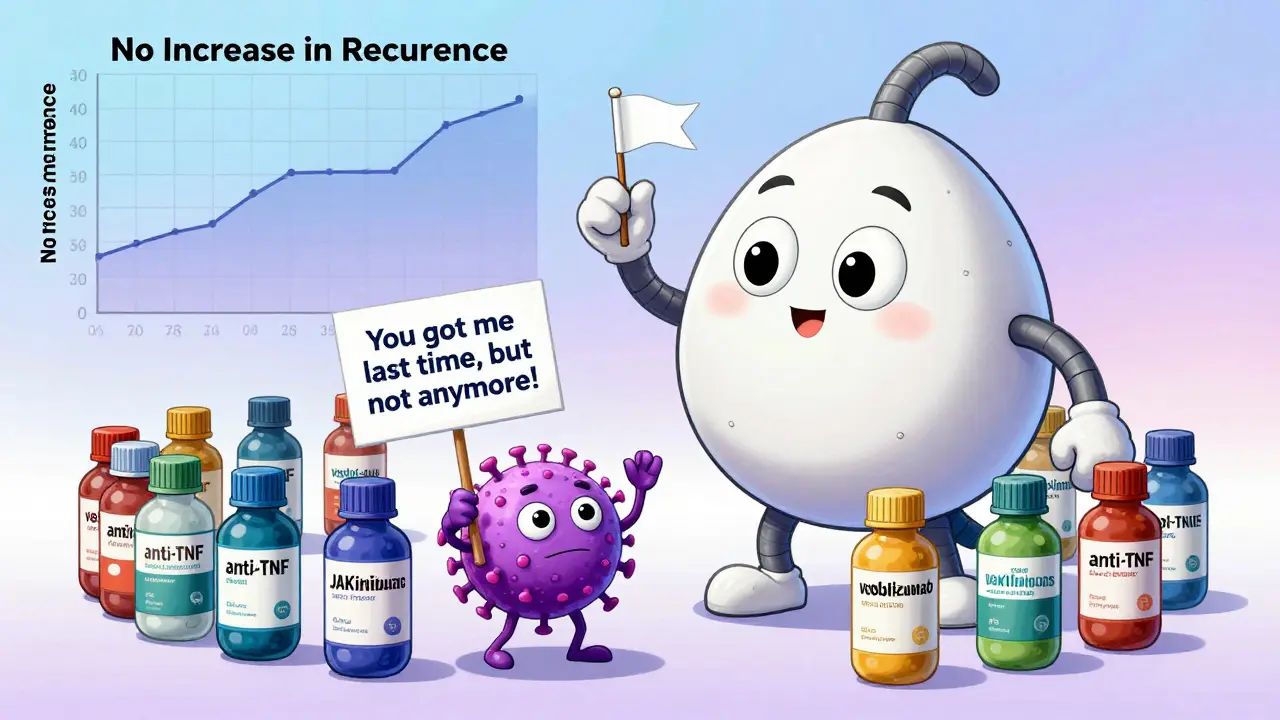
What should you do now?
If you’ve had cancer and need immunosuppressants for an autoimmune disease, here’s what matters:- Don’t wait five years. There’s no evidence it helps. Delaying treatment only increases your risk of joint damage, bowel complications, or skin disfigurement.
- Work with your care team. Your rheumatologist, gastroenterologist, or dermatologist should talk to your oncologist. Share your cancer type, stage, when you finished treatment, and whether you’re still in remission.
- Choose the right drug. For most people, anti-TNF or newer biologics are safe. If you had melanoma, your doctor might lean toward vedolizumab or ustekinumab - drugs with less systemic immune suppression.
- Stay on top of screenings. Even if your drug doesn’t raise recurrence risk, you’re still a cancer survivor. Keep up with mammograms, colonoscopies, skin checks, and blood tests. Surveillance doesn’t stop just because you’re on immunosuppressants.
What’s changing in practice
Before 2016, many doctors refused to prescribe immunosuppressants to cancer survivors. Now, prescription rates for these drugs in patients with prior cancer histories have jumped 18.7% since 2017, according to IQVIA data. That’s because doctors finally have real numbers to go on. EULAR’s 2023 guidelines say it clearly: “Treatment decisions should be based on cancer-specific factors including type, stage, time since remission, and prognosis, rather than a uniform waiting period.” That’s a huge shift - from blanket rules to personalized care. In Melbourne, where I live, clinics now routinely hold multidisciplinary meetings for patients with autoimmune disease and cancer histories. Oncologists, rheumatologists, and GI specialists sit down together. No one is making decisions alone anymore.
What’s still being studied
We’re not done. Two major studies are underway:- RECOVER (NCT04567821): Tracking 1,200 IBD patients with prior cancer to see how different drugs affect recurrence over time. Preliminary results expected in mid-2026.
- RHEUM-CARE (NCT04321987): Following 5,000 RA patients with cancer histories to pinpoint which drug-cancer combinations might still carry risk.
What to ask your doctor
Don’t leave these conversations to chance. Bring these questions to your next appointment:- What type of cancer did I have, and what’s my current risk of recurrence?
- Has my cancer been in remission long enough to consider immunosuppressants?
- Which immunosuppressant do you recommend, and why?
- Will I need more frequent cancer screenings while on this drug?
- Are there any signs of recurrence I should watch for?
The big picture
This isn’t just about drugs. It’s about dignity. For years, patients were forced to choose between managing their pain and fearing cancer. That’s not a choice - it’s a trap. The science now says: you can have both. You can control your arthritis, your Crohn’s, your psoriasis - without increasing your cancer risk. The old rule was wrong. The new evidence is solid. Your health shouldn’t be held hostage by outdated assumptions. Talk to your team. Get the care you need. Your body - and your life - deserve better.Do immunosuppressants increase the risk of cancer coming back?
No, not according to the latest and largest studies. Research involving over 24,000 patients with prior cancer diagnoses found no increased risk of recurrence with anti-TNF drugs, traditional immunomodulators like methotrexate, or newer biologics like ustekinumab or JAK inhibitors. The timing of when you restart these drugs - even within five years of cancer treatment - doesn’t affect your risk.
Is it safe to take immunosuppressants after having melanoma?
Melanoma is a special case. Because it’s highly responsive to immune surveillance, some doctors still recommend extra caution. If your melanoma was early-stage and fully removed, many experts now consider immunosuppressants safe - especially drugs like vedolizumab or ustekinumab that target the gut or skin more selectively. But if your melanoma was advanced or recently treated, your oncologist may advise waiting longer or choosing a different treatment path. Always discuss this with both your dermatologist and rheumatologist.
Should I wait five years before restarting immunosuppressants after cancer?
No. The five-year waiting rule was based on fear, not science. Multiple large studies have shown no benefit to delaying treatment. Waiting can lead to worsening joint damage, uncontrolled bowel disease, or severe skin symptoms. Today’s guidelines recommend making decisions based on your specific cancer type, stage, and remission status - not an arbitrary time limit.
Which immunosuppressant is safest after cancer?
All major classes - anti-TNF agents, methotrexate, azathioprine, JAK inhibitors, ustekinumab, and vedolizumab - show similar safety profiles in cancer survivors. Some newer biologics, like vedolizumab (which acts mostly in the gut) or ustekinumab (which targets specific immune pathways), may be preferred in patients with melanoma or blood cancers because they cause less broad immune suppression. But no single drug is proven safer overall. The best choice depends on your autoimmune condition, cancer history, and overall health.
Do I still need cancer screenings if I’m on immunosuppressants?
Yes, absolutely. Being on immunosuppressants doesn’t mean you’re no longer at risk for new cancers or recurrence. In fact, you should be even more vigilant. Stick to your scheduled mammograms, colonoscopies, skin checks, and blood tests. Your oncologist will guide you on how often to screen based on your cancer type and history. These screenings are your safety net - don’t skip them.


Post A Comment