
LDL Reduction Calculator
How Combination Therapy Works
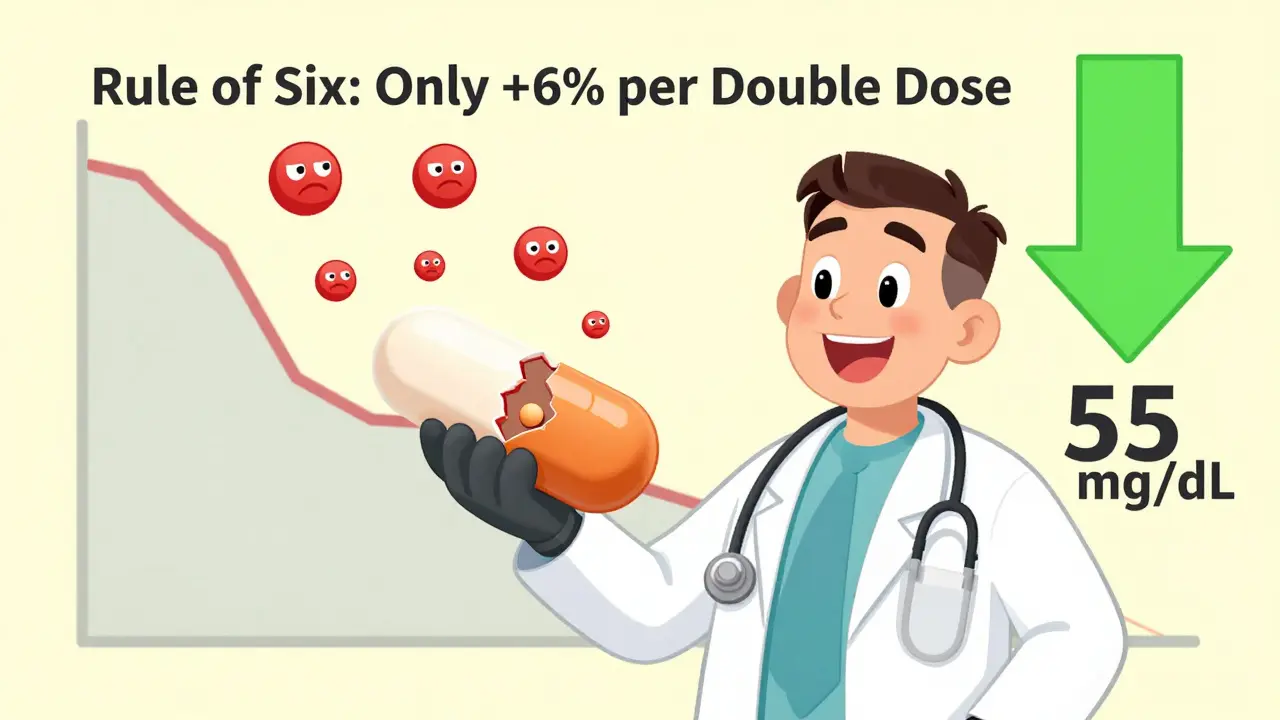
The "Rule of Six": Each time you double your statin dose, you get about 6% more LDL reduction. Combination therapy multiplies the effect - ezetimibe works on the LDL the statin didn't touch. Every 39 mg/dL LDL drop cuts heart risk by 22%.
Results
LDL Reduction:
Your LDL After Therapy:
Risk Reduction:
How combination therapy works: If a statin lowers LDL by 40%, and ezetimibe lowers it by 20%, you get 52% reduction - not 60%. This is because ezetimibe targets the 60% of cholesterol the statin didn't touch. The IMPROVE-IT trial showed 6% fewer heart attacks with combination therapy.
For years, doctors have reached for higher statin doses to push LDL cholesterol lower. But there’s a better way - one that works faster, causes fewer side effects, and gets more patients to their target. It’s not about taking more statin. It’s about taking less statin and adding something else.
Why Bigger Statin Doses Don’t Work Like You Think
Statin pills like atorvastatin and rosuvastatin are powerful. But their power hits a wall. Doubling the dose doesn’t double the LDL reduction. In fact, it barely helps. A 2023 study in the Journal of the American College of Cardiology showed that going from 10mg to 20mg of atorvastatin only added 6% more LDL lowering. That’s the rule of six: each time you double the statin dose, you get about 6% more LDL reduction. That’s it.So if you’re on 80mg of atorvastatin and your LDL is still too high, increasing the dose further won’t help much - and it’ll likely make side effects worse. Muscle aches, fatigue, liver enzyme spikes - these are common with high-dose statins. About 10% to 15% of people can’t stay on them long-term. Some quit because they feel bad. Others quit because their doctor tells them to, fearing harm.
The Real Secret: Add, Don’t Boost
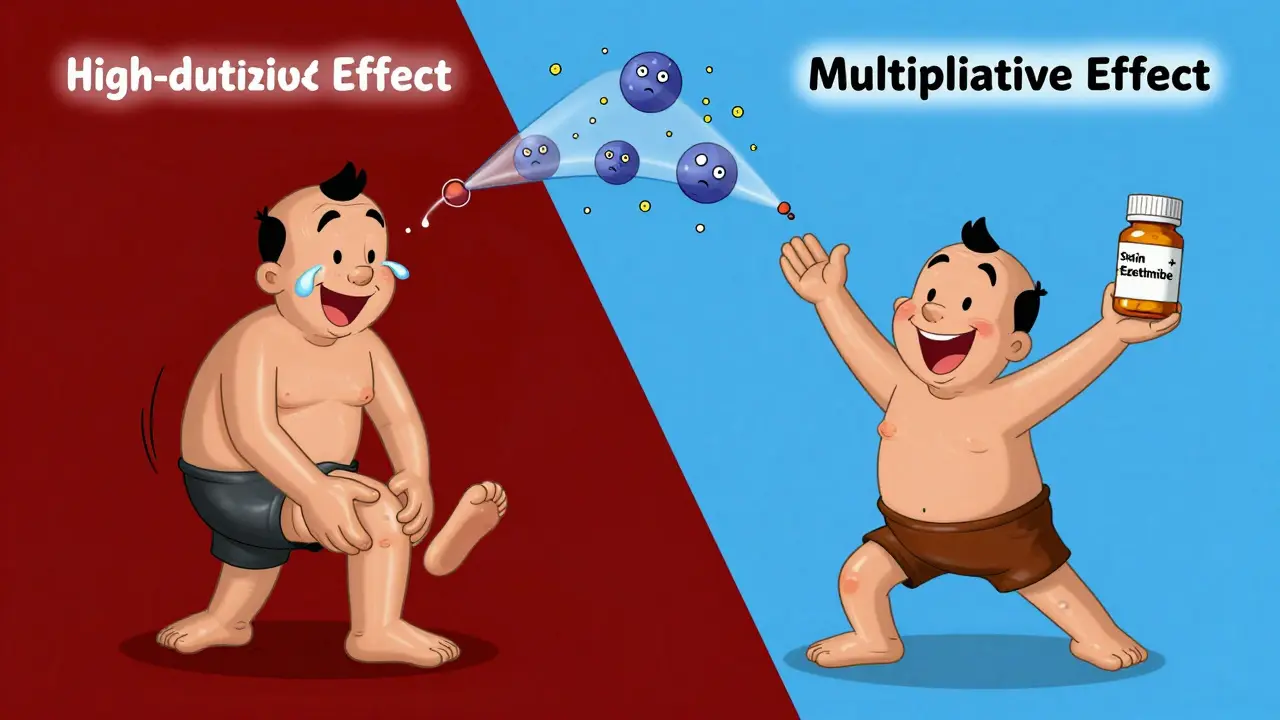
Instead of pushing statin doses higher, doctors are now adding a second drug - one that works differently. The most common partner? Ezetimibe. It blocks cholesterol absorption in the gut. Alone, it lowers LDL by about 20%. But when you combine it with a moderate statin, the effect isn’t just added. It’s multiplied.Here’s how it works: if a statin lowers LDL by 40%, and ezetimibe lowers it by 20%, you don’t get 60%. You get 52%. Why? Because ezetimibe acts on the 60% of cholesterol the statin didn’t touch. That’s the math: 40% + (20% of 60%) = 52%. That’s better than high-dose statin alone - which typically hits 50%. And it’s safer.
Studies back this up. A 2025 meta-analysis of nearly 19,000 patients found that adding ezetimibe to a statin lowered LDL by 23.7 mg/dL more than just doubling the statin dose. More patients hit their target. Fewer had side effects. And the benefits lasted. The IMPROVE-IT trial showed that patients on statin plus ezetimibe had 6% fewer heart attacks and strokes over seven years compared to statin alone.
Who Benefits Most?
This approach isn’t for everyone. It’s best for people at very high risk:- Those who’ve had a heart attack or stroke
- People with diabetes plus other risk factors
- Patients with familial hypercholesterolemia - a genetic condition that skyrockets LDL from birth
- Anyone who can’t tolerate high-dose statins
For these patients, guidelines now recommend an LDL target of under 55 mg/dL. Getting there with a high-dose statin alone is tough. With moderate statin plus ezetimibe? It’s doable. A 2024 European Heart Journal study showed 78.5% of high-risk patients reached their target with combination therapy - compared to just 62.3% on statin alone.
There’s also bempedoic acid, a newer drug that works in the liver - the same place statins do - but without entering muscle tissue. That’s why it causes far fewer muscle problems. In the CLEAR Harmony trial, patients on moderate statin plus bempedoic acid saw LDL drop as much as those on high-dose statin - but with 25% fewer muscle-related complaints.
Cost and Access: The Hidden Hurdle
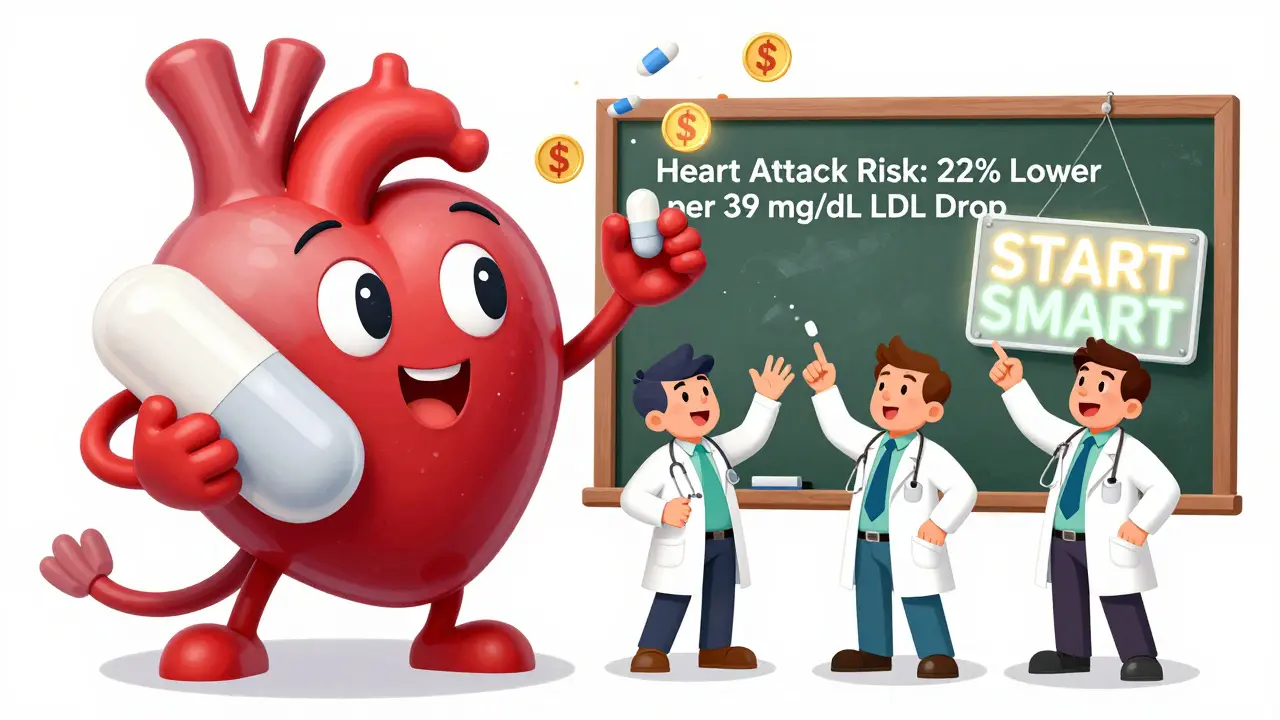
Ezetimibe is cheap. Generic, under $10 a month. Bempedoic acid? More expensive. PCSK9 inhibitors like evolocumab and alirocumab? Even more. They’re injectables that lower LDL by 60%, but they cost $10,000 a year. Insurance often blocks them unless you’ve tried everything else.Still, the math makes sense. Every 39 mg/dL drop in LDL - whether from statin, ezetimibe, or PCSK9 - cuts heart risk by 22%. So if a $300-a-year combo drug prevents a heart attack that costs $100,000 to treat, it’s a win. But many doctors still don’t prescribe it early. A 2023 study in JAMA Internal Medicine found only 25% of eligible patients got combination therapy. Why? Habit. Fear of complexity. Insurance delays.
Real Patients, Real Results
Take a 68-year-old man who had a heart attack. He was on 80mg of atorvastatin. His LDL was 82. Too high. He had muscle pain every time he tried to increase the dose. His doctor switched him to 40mg of atorvastatin plus 10mg of ezetimibe. Within six weeks, his LDL dropped to 64. No pain. No complaints. He’s been on it for two years.This isn’t rare. Cardiologists report that 30% to 40% of their high-risk patients need combination therapy to reach targets. And adherence? Much higher. When patients aren’t suffering side effects, they stick with it. One European study found 85% of statin-intolerant patients stayed on combination therapy after one year. Only 50% stayed on repeated statin attempts.
What’s Next?
Guidelines are catching up. The 2023 ACC Expert Consensus now says: for very high-risk patients needing more than 50% LDL reduction, start with a moderate statin plus ezetimibe. Not a high-dose statin. Not after failure. Start here.The European Society of Cardiology is expected to update its guidelines in 2025 - and leaked drafts suggest they’ll make this a top recommendation. That’s a big shift. For decades, the rule was: start with the strongest statin. Now, the rule is: start smart.
Doctors are learning. Lipid specialists surveyed in 2024 said 78% now begin with combination therapy for very high-risk patients. That’s up from 30% just five years ago. The change isn’t just science - it’s experience. More patients are hitting targets. Fewer are quitting. And heart attacks are dropping.
What You Can Do
If you’re on a high-dose statin and still not at your LDL goal - or if you’re struggling with side effects - talk to your doctor. Ask: “Would adding ezetimibe help me reach my target without increasing my statin dose?” Bring up the rule of six. Mention the data. Most doctors know it. But many haven’t made the switch yet.Don’t assume higher is better. Sometimes, less is more - especially when you add the right partner.
Is combination cholesterol therapy safer than high-dose statins?
Yes, for many people. High-dose statins cause muscle pain, fatigue, and liver enzyme changes in 10% to 15% of users. Combination therapy with a moderate statin and ezetimibe or bempedoic acid reduces those side effects by up to 25%, according to clinical trials like CLEAR Harmony. Fewer side effects mean fewer people stop taking their meds - which is critical for long-term heart protection.
How much does ezetimibe lower LDL when combined with a statin?
Ezetimibe adds about 15% to 20% more LDL reduction on top of a moderate statin. When you combine them, total LDL reduction typically reaches 50% to 55%, which is better than high-dose statin monotherapy (around 50%). The key is the multiplicative effect: ezetimibe works on the cholesterol the statin didn’t touch, making the combo more powerful than either drug alone.
Can I switch from high-dose statin to combination therapy on my own?
No. Never change your medication without talking to your doctor. Stopping or adjusting statins suddenly can raise your LDL quickly, increasing heart risk. Your doctor will guide you through a safe transition - often by lowering the statin dose and adding ezetimibe or another agent over a few weeks while monitoring your cholesterol levels.
Is combination therapy covered by insurance?
Ezetimibe is generic and usually covered with low copays. Bempedoic acid and PCSK9 inhibitors often require prior authorization because they’re more expensive. Many insurers will approve them only after you’ve tried and failed on statins or ezetimibe. But if you have a history of statin intolerance or very high-risk conditions like recent heart attack, your doctor can appeal with supporting lab results and clinical notes.
How long does it take to see results with combination therapy?
You’ll typically see LDL reductions within 4 to 6 weeks. A 2024 study showed patients on statin plus ezetimibe reached their target 4.2 months faster than those on statin alone. That’s important for people who’ve had a recent heart event - every day counts.
Does combination therapy reduce heart attacks and strokes?
Yes. The IMPROVE-IT trial proved that adding ezetimibe to a statin reduced heart attacks and strokes by 6% over seven years. PCSK9 inhibitors reduced events by 15%. The benefit comes from lowering LDL - no matter how you do it. Every 39 mg/dL drop in LDL cuts cardiovascular risk by 22%. Combination therapy gets you there faster and with fewer side effects.


Post A Comment