
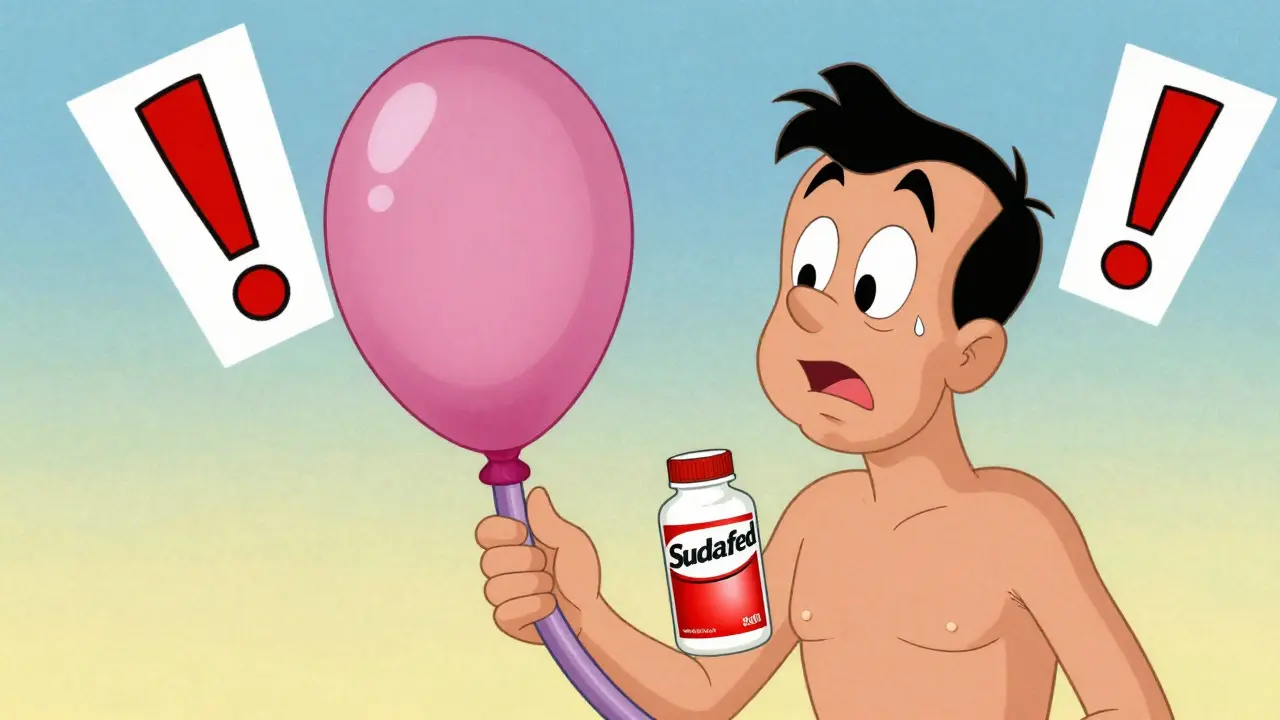
BPH Decongestant Risk Calculator
Assess your risk of urinary retention when using decongestants with benign prostatic hyperplasia (BPH). Based on data from the Journal of Urology and American Urological Association guidelines.
Important Facts
- Men over 70 with BPH have 51.8% risk of voiding dysfunction with pseudoephedrine
- Pseudoephedrine increases urinary retention risk by 2.8x
- Phenylephrine increases risk by 2.15x
- Age and BPH severity are key factors
Your Risk Assessment
Safe alternatives include saline nasal irrigation, intranasal corticosteroids, or second-generation antihistamines like loratadine or cetirizine.
| Risk Factor | Impact |
|---|---|
| Age > 70 | +30% risk |
| Severe BPH | +25% risk |
| Pseudoephedrine | 2.8x increased risk |
| Phenylephrine | 2.15x increased risk |
Men with an enlarged prostate-known as benign prostatic hyperplasia (BPH)-often face a quiet but serious danger from common cold and allergy medicines. You might not realize it, but a simple tablet of pseudoephedrine, found in many over-the-counter decongestants, can trigger a medical emergency: acute urinary retention. This isn’t rare. It’s predictable. And it’s preventable.
What Is Benign Prostatic Hyperplasia?
BPH isn’t cancer. It’s not life-threatening. But it’s incredibly common. By age 60, about half of all men have some degree of prostate enlargement. By 85, that number jumps to 90%. The prostate wraps around the urethra-the tube that carries urine out of the body. As it grows, it squeezes the urethra shut, making it harder to start peeing, weakens the stream, and leaves you feeling like your bladder never fully empties.
These symptoms aren’t just annoying-they’re disruptive. Nighttime urination, urgency, straining, and dribbling become part of daily life. But here’s the hidden risk: many men don’t connect their worsening symptoms to something they took for a stuffy nose.
How Decongestants Make BPH Worse
Decongestants like pseudoephedrine (Sudafed) and phenylephrine work by tightening blood vessels in the nose to reduce swelling. But they don’t stop there. These drugs activate alpha-1 adrenergic receptors-same ones found in high concentration in the prostate and bladder neck. When triggered, these receptors cause the smooth muscle in those areas to contract.
Think of it like squeezing a straw from the inside. The prostate, already enlarged, tightens even more. The bladder neck closes tighter. Urine flow drops. In healthy men, this might cause mild discomfort. In men with BPH, it can completely block urine flow.
Studies show pseudoephedrine increases urethral resistance by 35-40%. One double-blind trial at Massachusetts General Hospital found a 27% drop in maximum urinary flow rate in men over 50 with BPH after a single 30mg dose. That’s not a small change-it’s enough to stop urination entirely.
The Real Risk: Acute Urinary Retention
Acute urinary retention means you can’t pee at all, even though your bladder is full. It’s painful. It’s scary. And it’s an emergency.
According to a 2021 study in the Journal of Urology, men with BPH who take pseudoephedrine are 2.8 times more likely to develop acute urinary retention. The risk jumps even higher with age. Men over 70 using pseudoephedrine have a 51.8% chance of developing subclinical voiding dysfunction-meaning their bladder function is already damaged, even if they don’t feel it yet.
And it’s not just pseudoephedrine. Phenylephrine, another common decongestant, carries a lower but still significant risk-15-20% increase in urethral resistance. Even nasal sprays like oxymetazoline (Afrin) can be risky if used too long or too often, though their systemic absorption is lower.
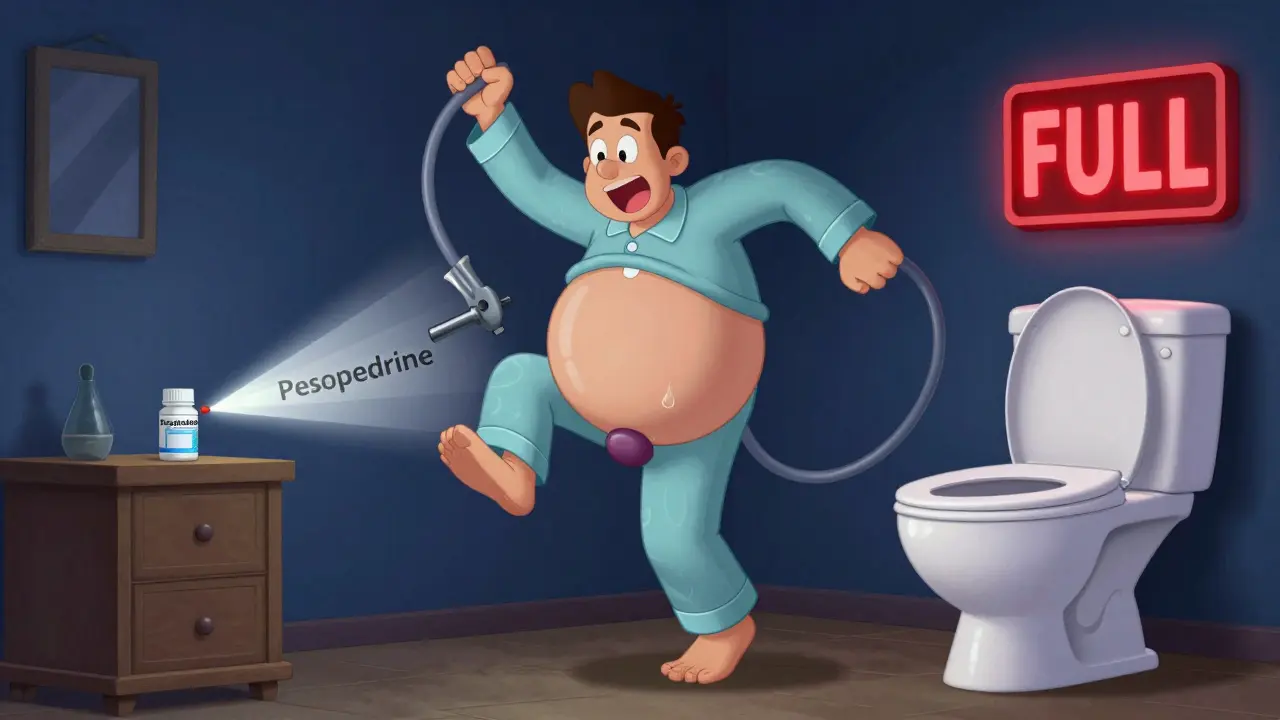
Here’s what happens in real life: a man takes a Sudafed tablet for his cold. He goes to bed. He wakes up needing to pee. He tries. Nothing comes out. His bladder swells. He feels pressure, pain, nausea. He ends up in the ER. A catheter is inserted. He spends 48-72 hours with a tube in his penis. That’s not unusual. Research from the University of Michigan found 70% of BPH patients who had urinary retention after decongestants needed catheterization.
Who’s Most at Risk?
It’s not just about having BPH. It’s about how severe it is. Men with moderate to severe symptoms (IPSS score above 12) are at the highest risk. Age matters too. Men over 65 are 3.5 times more likely to experience retention than younger men with the same level of prostate enlargement.
But here’s the twist: some men with mild BPH (IPSS under 8) may tolerate occasional decongestant use without issues. That’s why blanket warnings aren’t always helpful. The real answer lies in knowing your symptoms and talking to your doctor.
What Alternatives Actually Work?
You don’t need decongestants to breathe better. There are safer, proven options:
- Saline nasal irrigation (like NeilMed Sinus Rinse): Effective for 68% of users with no urinary side effects. It flushes out mucus and allergens without touching your prostate.
- Intranasal corticosteroids (fluticasone, mometasone): Reduce nasal inflammation long-term. Studies show 72% effectiveness with zero urinary risk.
- Loratadine (Claritin) or cetirizine (Zyrtec): Second-generation antihistamines. They don’t cause urinary retention like first-gen ones (diphenhydramine/Benadryl), which have an odds ratio of 2.85 for retention.
- Steam inhalation and humidifiers: Simple, free, and safe. Helps loosen congestion without any drug interaction.
On Amazon, 82% of users who switched to saline rinses rated them ‘very effective’ for congestion without worsening BPH symptoms. That’s a powerful alternative.
What If You Really Need a Decongestant?
There are rare cases where a doctor might approve short-term decongestant use-for example, if you’re recovering from sinus surgery and have no other options. But even then, there are rules.
The American Pharmacists Association recommends:
- Never use pseudoephedrine for more than 48 hours without consulting a doctor.
- Use the lowest effective dose: 30mg max per day.
- Take it with an alpha-blocker like tamsulosin (Flomax). A 2022 Cleveland Clinic study showed this combo reduced urinary retention risk by 85%.
- Monitor symptoms closely. If your stream slows, you feel pressure, or you can’t fully empty your bladder-stop immediately.
And never, ever take decongestants if you’ve had urinary retention before. That’s a red flag. The risk isn’t worth it.

What the Experts Say
Dr. Claus Roehrborn, lead author of the American Urological Association’s BPH guidelines, says: “Pseudoephedrine should be considered contraindicated for men over 50 with moderate to severe BPH.”
The European Association of Urology goes further: they recommend complete avoidance of all systemic alpha-agonists in men with BPH. Their data shows a 92% success rate in preventing medication-induced retention through simple medication reviews.
The FDA now requires warning labels on all pseudoephedrine products since January 2022. But awareness is still low. In 2021, only 28% of men with BPH knew about this risk. By 2023, that rose to 63%-still not enough.
Meanwhile, the American Geriatrics Society lists pseudoephedrine as a “potentially inappropriate medication” for men over 65 with BPH. That’s the same level of warning they give to drugs that can cause falls or confusion in the elderly.
Real Stories, Real Consequences
Reddit user u/BPH_Warrior wrote: “I took one 30mg Sudafed tablet for my cold. I couldn’t pee. My bladder felt like it was going to burst. I ended up in the ER. I had a catheter in for 12 hours. I didn’t think a cold medicine could do that.”
On the Prostate Cancer Foundation forum, 76% of 187 users reported urinary problems after taking pseudoephedrine. Over 30% needed emergency catheterization.
But not everyone has the same reaction. One user on Drugs.com said: “I’m 68 with mild BPH. I’ve taken Sudafed for years with no issues.” That’s true for some. But it’s not safe to assume you’re one of them. The risk isn’t personal-it’s physiological. And it builds up over time.
What You Should Do Now
If you have BPH and you’re about to take a decongestant, stop. Ask yourself:
- Do I know how severe my BPH symptoms are?
- Have I ever had trouble starting or stopping my urine stream?
- Have I ever felt like my bladder didn’t empty?
- Am I over 50?
If you answered yes to any of those, avoid pseudoephedrine and phenylephrine. Period.
Instead, try saline rinses. Use a nasal steroid spray. Take loratadine for allergies. Talk to your pharmacist before buying anything labeled “for congestion.” They’re trained to spot this risk now.
And if you’ve already taken a decongestant and can’t pee? Don’t wait. Don’t drink more water. Don’t hope it’ll pass. Go to the ER. Urinary retention can damage your kidneys if left untreated.
This isn’t about fear. It’s about awareness. You don’t need to suffer from a cold to protect your bladder. There are safe choices. You just need to know what they are.
Can pseudoephedrine cause urinary retention in men with BPH?
Yes. Pseudoephedrine is a strong alpha-1 adrenergic agonist that tightens smooth muscle in the prostate and bladder neck. In men with benign prostatic hyperplasia (BPH), this can block urine flow completely, leading to acute urinary retention. Studies show it increases the risk by 2.8-fold. The American Urological Association lists it as a high-risk medication for BPH patients.
Is phenylephrine safer than pseudoephedrine for BPH patients?
Phenylephrine is less potent than pseudoephedrine, causing only a 15-20% increase in urethral resistance compared to 35-40% for pseudoephedrine. But it still carries a significant risk-odds ratio of 2.15 for urinary retention. It’s not safe, just slightly less dangerous. Avoid both if you have moderate to severe BPH.
What’s the safest decongestant for someone with BPH?
There is no truly safe oral decongestant for men with BPH. The safest options are non-drug treatments: saline nasal irrigation and intranasal corticosteroids like fluticasone. These reduce congestion without affecting the prostate. If you need an antihistamine, choose loratadine (Claritin) or cetirizine (Zyrtec)-they don’t cause urinary retention like diphenhydramine (Benadryl).
Can I take pseudoephedrine if I’m on tamsulosin (Flomax)?
Even if you’re taking tamsulosin, pseudoephedrine can still cause retention. However, a 2022 study from Cleveland Clinic showed that taking tamsulosin (0.4mg daily) for at least 72 hours before using pseudoephedrine reduced the risk of retention by 85%. This is not a green light-it’s a last-resort safety net. Always consult your urologist before combining these.
How do I know if I’m experiencing urinary retention?
Signs include: inability to start urination, weak or interrupted stream, feeling like your bladder is full but nothing comes out, lower abdominal pain or pressure, and sudden urgency without results. If you’ve taken a decongestant and notice these symptoms, stop the medication immediately and seek medical help. Do not wait.
Should I avoid all cold medicines if I have BPH?
No-but you must read labels carefully. Avoid any product containing pseudoephedrine, phenylephrine, or ephedrine. Many multi-symptom cold remedies include these. Look for products labeled “non-drowsy” or “sinus relief” and check the active ingredients. Saline sprays, nasal steroids, and antihistamines like loratadine are safe alternatives. Always ask your pharmacist to check the label.
Are there any new treatments to prevent decongestant-induced retention?
Yes. Purdue Pharma’s experimental drug PF-06943303, a bladder-selective alpha-1D antagonist, showed 92% effectiveness in preventing pseudoephedrine-induced retention in Phase II trials. The NIH is also funding research into combination therapies. But these are still in development. For now, avoidance and safer alternatives remain the best strategy.


Post A Comment