

PRO Reporting Impact Calculator
How Your Reporting Makes a Difference
Your symptom reports directly impact drug safety monitoring. This tool shows how consistent reporting can help detect side effects faster and lead to treatment adjustments.
Calculate Your Impact
Your Reporting Impact
Enter your details and click Calculate to see how your reporting helps
Why This Matters
Did you know? According to the article, 78% of patients felt more involved in their care when asked to report symptoms. And 65% said they felt heard.
The FDA study mentioned found patients reported 30-40% more adverse events than clinicians did. Your reports help catch symptoms that might not show up in blood tests or physical exams.
When you take a new medication, you’re not just a passive recipient-you’re a critical part of the safety system. Patient-Reported Outcomes (PROs) are your direct, unfiltered reports about how a drug affects you: the fatigue, the nausea, the brain fog, the sleepless nights. These aren’t guesses by doctors or summaries by nurses. They’re your words, your experiences, and they’re now changing how drugs are monitored for safety.
Why Your Voice Matters More Than You Think
For decades, drug safety relied mostly on what doctors and nurses recorded during clinic visits. But many side effects never make it to those records. A 2019 FDA study found that patients reported 30-40% more adverse events than clinicians did. Fatigue? Patients mentioned it 4.2 times more often. Nerve pain? 3.8 times more. Cognitive trouble? Five times more. Why? Because some symptoms don’t show up in blood tests or physical exams. They only exist in how you feel. The FDA defines a PRO as a report that comes directly from a patient-with no interpretation from anyone else. That means if you say, “I can’t hold a cup without my hands shaking,” that’s data. Not an opinion. Not a complaint. Data. And it’s now part of the official review process for new drugs.How PROs Are Collected Today
You won’t always fill out paper forms anymore. Most clinical trials now use electronic PROs (ePROs)-apps on your phone, web portals, or even automated voice calls. These systems send you reminders, track your responses, and make it easier to report symptoms in real time. The most common tools are validated questionnaires. For cancer drugs, regulators now expect three core areas to be tracked:- Symptomatic adverse events-using PRO-CTCAE, a 78-item tool that asks you to rate symptoms like nausea, pain, or dizziness on both frequency and severity.
- Physical function-measured with PROMIS tools that ask questions like, “Can you lift a gallon of milk?” or “Can you walk a block without stopping?”
- Disease-specific symptoms-for example, the EORTC QLQ-C30 for cancer patients, which asks about appetite loss, diarrhea, or emotional distress.
Real Impact: When Your Reports Change Treatment
One breast cancer patient on MedHelp shared: “Reporting my side effects through the CTCAE-PRO app helped my oncologist adjust my dose before I ended up in the ER.” That’s not an exception. It’s becoming the norm. A 2022 survey of 1,247 patients across 12 trials found that 78% felt more involved in their care because they were asked to report symptoms. Another 65% said they felt heard. But not everyone has a positive experience. Some patients report being overwhelmed-filling out three different surveys three times a week. That’s not patient-centered. That’s burnout. The key is balance. Too few surveys, and you miss early warning signs. Too many, and people stop responding. The best systems use smart triggers: if you report worsening fatigue for two days in a row, the system alerts your care team. If your answers stay stable, you get a break.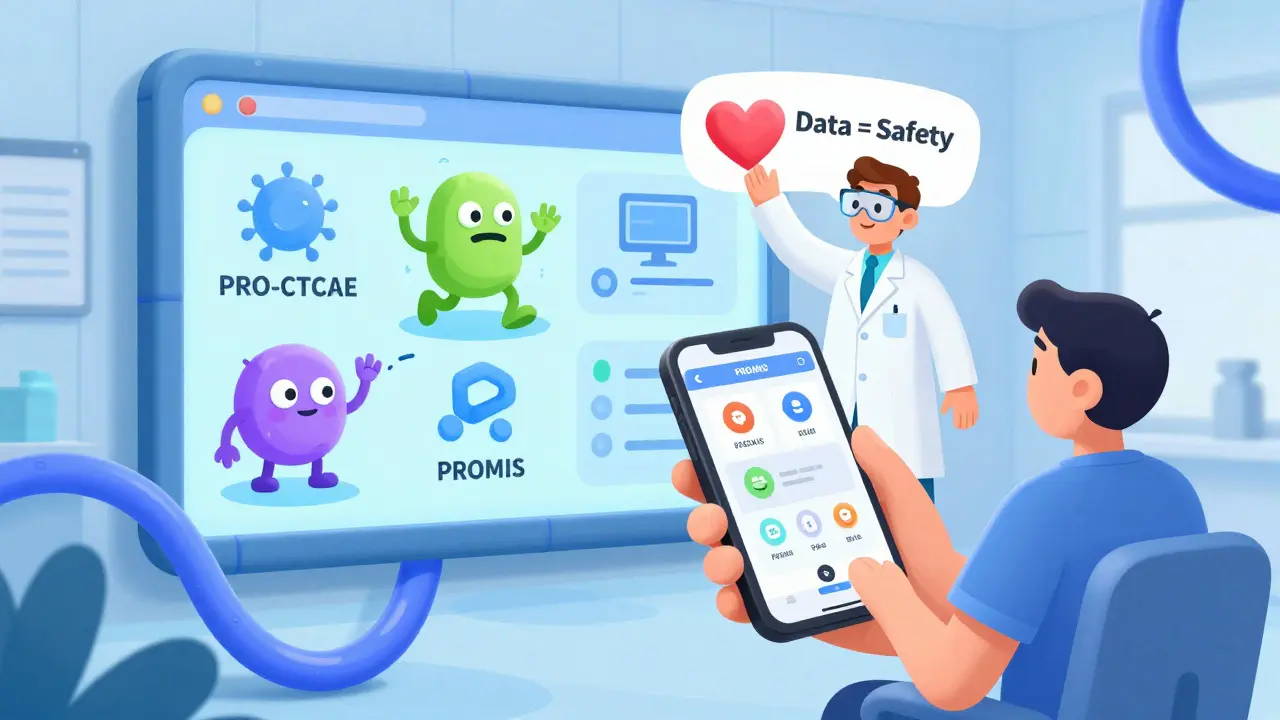
Where PROs Are Making the Biggest Difference
Not all diseases use PROs equally. Oncology leads the way-89% of late-stage cancer trials now include them. Why? Because cancer treatments often cause symptoms that don’t show up in labs. Patients need to tell doctors what they’re feeling to avoid dangerous drops in quality of life. Rare diseases are next, at 76%. For conditions with few patients, every voice counts. If 10 people out of 500 report the same unusual side effect, that’s a signal worth investigating. Mental health is catching up. Depression, anxiety, and cognitive side effects are hard to measure with scans or blood tests. PROs fill that gap. But surgical treatments? Only 32% of trials collect them. That’s a missed opportunity. Pain, mobility, and recovery speed are all things patients notice-and should be tracked.The Tech Behind the Data
New tools are making PROs smarter. Roche started using AI to scan patient comments in open-text fields and automatically flag potential adverse events. In tests, it caught 82% of issues correctly. Pfizer tested wearables in an atopic dermatitis trial and found that 73% of patient-reported itching matched up with motion sensors detecting scratching. That’s powerful validation. Novartis is using blockchain to secure PRO data. Why? Because patients worry about privacy. If you report depression or substance use, you don’t want that data leaking. Blockchain doesn’t mean cryptocurrency-it means tamper-proof logs that only authorized people can access.
Challenges and Pitfalls
PROs aren’t perfect. Recall bias is real. If you forget to report a symptom for three days, you might misremember how bad it was. Studies show accuracy drops by about 25% for events recalled beyond a week. That’s why daily reporting matters. Language and literacy matter too. If a survey is written in complex medical terms, people with lower education or non-native English struggle. Translation isn’t just word-for-word-it’s cultural. A forward-backward translation process (translate, then translate back to check) costs around $25,000 per language but is essential. And then there’s feedback. A shocking 68% of patients in the National Health Council survey said they never got any response to their reports. “I filled out the forms, but no one ever told me if it mattered.” That’s a trust breaker. If you report something, you should know whether it changed anything.What’s Coming Next
By 2026, the European Medicines Agency plans to require PRO data for every new drug approval. The FDA is already moving in that direction. The 2022 draft guidance for cancer drugs is expected to become final in late 2024-and it’s likely to be the model for other diseases. The global market for PRO tools is growing fast. It was worth $1.87 billion in 2022 and is projected to hit $3.89 billion by 2028. Every major pharmaceutical company now has a dedicated PRO team. Why? Because regulators demand it. And because patients demand to be heard.Your Role in the System
You don’t need to be a scientist to make a difference. If you’re in a clinical trial or taking a new medication, your reports matter. Don’t skip surveys. Don’t guess answers. Be honest-even if it feels uncomfortable. If you’re tired all the time, say so. If your hands go numb, write it down. If you feel worse after taking the pill, tell someone. And if you feel ignored? Ask: “Did my feedback help?” If the answer is no, push for change. Your voice isn’t just part of the system. It’s the reason the system exists.What exactly counts as a Patient-Reported Outcome?
A Patient-Reported Outcome (PRO) is any information about your health, symptoms, or treatment experience that comes directly from you-without interpretation by a doctor, nurse, or researcher. This includes how you feel on a daily basis, whether you’re in pain, how tired you are, or if you’ve had trouble sleeping. It’s not what a clinician observes-it’s what you report. Tools like the PRO-CTCAE or PROMIS questionnaires are used to collect this data in a standardized way.
Why are electronic PROs better than paper surveys?
Electronic PROs (ePROs) have higher response rates-85-92% compared to 65-75% for paper. They send automatic reminders, reduce errors from handwritten entries, and allow real-time data collection. If you report a sudden drop in mobility, your care team can be alerted the same day. Paper surveys get lost, delayed, or forgotten. ePROs keep you engaged and make your feedback more actionable.
Can I refuse to fill out PRO surveys in a clinical trial?
Yes. Participation in PRO collection is voluntary. You can opt out at any time without affecting your medical care. But keep in mind: your input helps researchers understand side effects and improve future treatments. If you skip surveys, your experience won’t be included in the data that shapes safer drugs for others. It’s your right to say no-but your voice might help someone else down the line.
Do PROs really lead to changes in my treatment?
Yes, and it’s happening more often. For example, if you consistently report severe fatigue, your doctor might reduce your dose or switch medications. In clinical trials, PRO data has led to earlier dose adjustments, delayed treatment starts, or even the removal of unsafe drugs from trials. One 2019 study found that PROs detected safety signals 28 days faster than traditional methods. Your feedback isn’t just recorded-it’s acted on.
What if I don’t understand the survey questions?
You’re not alone. Many patients find survey wording confusing. If a question doesn’t make sense, skip it or write a note. Most systems allow open-text responses. You can say, “I’m not sure what ‘physical function’ means” or “I feel dizzy, but I don’t know how to rate it.” Your confusion is valuable feedback too-it helps developers improve the tools. Ask your study coordinator for clarification. They’re there to help you understand, not just collect data.
Are PROs only for clinical trials?
No. While PROs are most common in trials, they’re increasingly used in routine care. Some hospitals now use PRO tools to track side effects after surgery or during chemotherapy. The FDA encourages their use beyond trials, especially for chronic conditions like diabetes or heart failure. Your feedback can help shape not just new drugs, but how existing ones are used in real life.


Post A Comment